







When Juan Manuel Moreno ran as a candidate in the 2018 Andalusian elections, he already told his supporters that his aspiration was to turn Andalusia, one of the poorest regions in Western Europe, into the “Bavaria of Spain,” an idea he reiterated four years later, shortly before achieving an absolute majority. Since coming to power, he has insisted that his community is becoming a “locomotive” of the country and that it will compete head-to-head with Madrid and Catalonia for leadership. During this time, some macroeconomic indicators — the community grows at a faster rate than the average and is one of the largest job creators in absolute numbers — have allowed Moreno to settle into a triumphalist discourse and his party to even talk about an “Andalusian economic miracle.” However, there are shadows over this discourse, and data that contradict these triumphalist theses.
Read more José María Cruz Novillo dies, the man who designed the great logos of democratic Spain
The reasons? Many, including the high weight of agriculture and tourism or the scarcity of large companies. The result is that in GDP per capita and poverty risk rate, indicators that the PP considered crucial from the opposition, Andalusia remains in the most unfavorable position. These are aspects that the popular baron does not mention, but which show that this supposed “miracle” is far from permeating the entire population.
“I don’t think there is any reason for triumphalism, on the contrary, there are reasons for concern, because the problems we already had have worsened,” says Manuel Delgado, professor of Economics at the University of Seville, referring to Andalusia’s dual condition as “supplier of raw materials” and “Europe’s waiter.”
Delgado emphasizes that the use of data by the Andalusian government is “misleading” because the improvement in specific figures is linked to that at the national level and because it is not reflected in the “well-being” of a large part of the population. Also because it ignores underlying problems. Experience shows that Andalusia always creates jobs faster in growth phases, like the one Spain is going through, but destroys them faster in crisis phases, because its structural deficits are not corrected.
According to Delgado, author of numerous essays on the Andalusian economy, there are two sectors illustrative of the negative dynamics of the Andalusian economy. The first, agriculture, with “intensive farming inserted in a chain in which the added value is appropriated by the large agribusiness companies, especially the distributors.” The second is tourism, where he points out that the main beneficiaries — hotel chains, airlines — are not Andalusian, while the associated costs — such as the rise in housing prices — are paid by the local population.
The burden of poverty
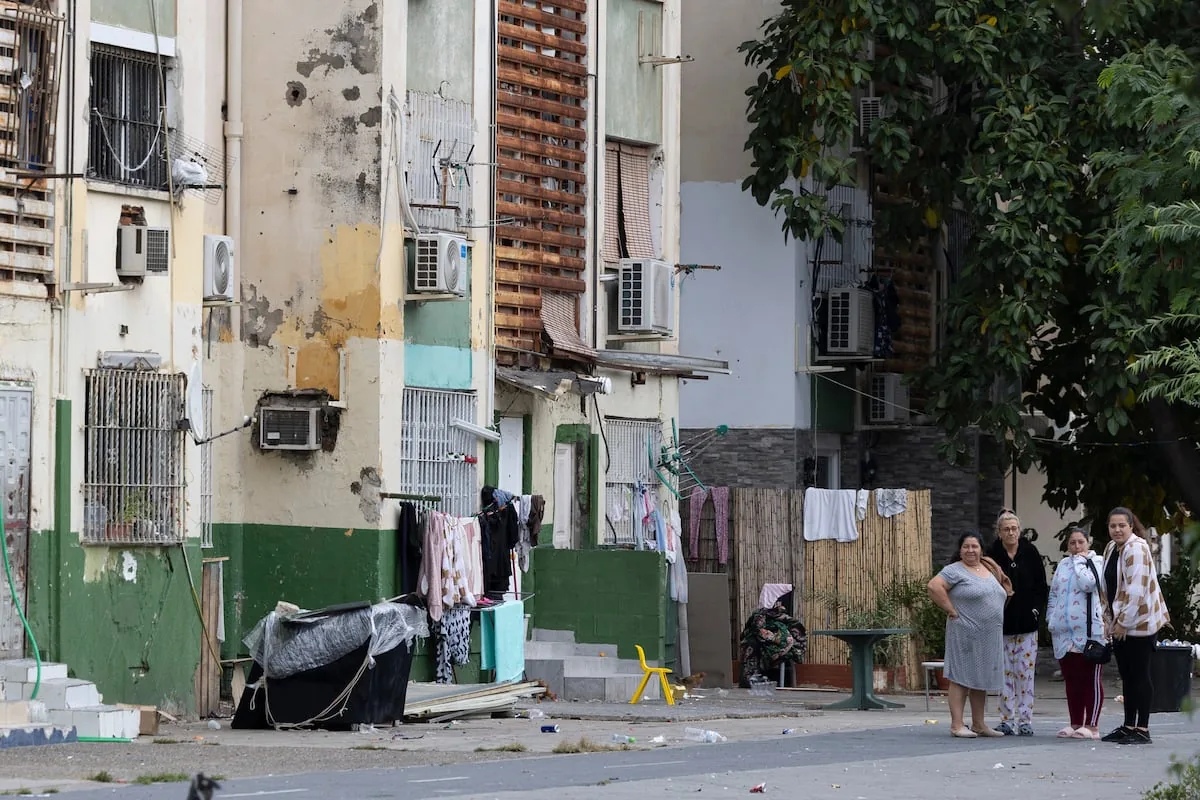
Laura Cárdenas is 48 years old and is one of those Andalusian women who have not noticed the prosperity the president refers to. Spokesperson for the Barrios Hartos collective, she lives with her 16-year-old daughter in La Negrilla, within the Cerro-Amate district, where Los Pajaritos is located, one of the poorest neighborhoods in Spain. She has been unemployed for two years and survives thanks to an unemployment subsidy of 500 euros, which she complements with the 200 euros she receives from the minimum vital income and help from her parents. “They are making us poor in a sneaky way,” she says.
Cárdenas is lucky because she finished paying off her apartment before being laid off, but many of her neighbors have been forced to return to their parents’ homes because they cannot afford the rise in housing costs. “It doesn’t matter if the minimum wage increases when housing has doubled, the shopping basket has skyrocketed, and electricity and gasoline keep rising,” she laments.
“Although it is true that the economy seems to be improving, the Arope and Foessa [from Cáritas] reports reveal the same reality: vulnerable people are not able to improve as they should. This is serious because we have a chronic poverty situation,” says Juan Luis Delcán, president of the Third Sector Table in Andalusia. Although the community has reduced the risk of poverty or social exclusion (Arope indicator) by almost three points between 2019 and 2024 (the latest published data), it remains at the worst rate in the country, 34.7%, well above the national 25.8%. Delcán warns how the cost of housing, food, and utilities is “putting the Andalusian middle class in an increasingly delicate situation.”
Both he and Macarena Olid, spokesperson for APDHA in Seville, warn that despite good employment data, where Andalusia for the first time has reached 14.66% — still 3.8 points behind the national average, according to the latest EPA — “getting a job no longer gets you out of poverty.” “Job insecurity forces many families to have two jobs, one to pay the mortgage and another to live,” warns Olid citing her organization, which warns how the average rent price increased by 11.8% in 2025, three times more than wages.
“There is so much to do and so much to keep quiet about that a little humility would be needed,” stresses Inmaculada Caravaca, researcher at the Inequality Observatory, who again focuses on a harsh reality: Andalusia has 10 of the 15 poorest neighborhoods in Spain, according to INE data.
Read more A man fatally stabs a woman in the street in Esplugues de Llobregat
No structural change
“We continue to drag deficits and delays, especially serious in the quality and remuneration of employment,” confirms Marcial Sánchez-Mosquera, associate professor in the Department of Economics and Economic History at the University of Seville, who draws attention to the evolution of one figure: the difference between the average Andalusian salary and the Spanish one was 2,203.2 euros in 2018; in 2023, the date of the latest Annual Survey of Wage Structure from INE, it has increased to 2,998.43. This shows “job creation through lower quality positions,” he points out. That increase in the wage gap also refutes, Sánchez-Mosquera argues, that any “structural change” is taking place. “If that change were underway, it would be reflected in the quality of employment,” he maintains.
José María O’Kean, professor of Applied Economics at Pablo de Olavide University, also does not consider that Moreno’s government has developed “policies that lead to a transformation of the economic dynamics” in these years. “More has been played on that institutional stability that generates a lot of confidence in the entrepreneur, but no major changes have been made either,” he observes, although he does consider that the PP’s management “has more lights than shadows.” However, he specifies that the longed-for convergence with the rest of the country will not come “while the business structure remains made up of microenterprises and self-employed workers.”
Self-employed, microenterprises, and investment
The growth in the number of self-employed and companies — Andalusia created the most in 2024 — is another argument the popular baron often presents as proof of his management. But these are data with fine print. Of the 565,000–570,000 Andalusian self-employed, 85% have no employees, according to data provided by the Institute of Statistics and Cartography of Andalusia (IECA) on the average of 2024 and 2025. “A self-employed person without workers is a sign of precariousness, because it is usually someone who self-employs out of necessity and does not have the labor protection of an employee,” warns Sánchez-Mosquera. Of the 644,749 active companies in the community as of January 1, 2024, nine out of ten are microenterprises, according to the latest published DIRCE, which also confirms that it is the territory that destroys the most companies in absolute terms.
Foreign investment or the establishment of large national companies — even if they do not pay taxes within the territory — are also elements frequently presented by Moreno as evidence of success. But among the experts consulted, there are doubts. “The exogenous development model, which has been pursued since the PSOE governments, does not work if there is no commitment to the development of the community,” emphasizes Sánchez-Mosquera, for whom policies should be aimed at “supporting and anchoring” companies that “guarantee commitment to the territory and its economy,” taking the Basque Country as a reference.
GDP per capita
Moreno warned this Monday, during the presentation of his electoral program, that “economic growth was necessary to redistribute wealth,” but the indicator that determines the average level of wealth and the degree of convergence with the rest of the territory, GDP per capita, remains elusive for Andalusia. With 24,542 euros per inhabitant, the southern community ranks at the bottom of Spain, more than 8,000 euros below the national average, according to INE.
O’Kean points out that both in Andalusia and Spain GDP per capita grows little largely due to the abundant influx of migrant population. “You have to divide among more people who are working in jobs that the native population does not want to do,” usually low-skilled jobs.
For the Andalusian case, the economist highlights two particularities that weigh down its GDP per capita. The first, the underground economy. At 17.9% of GDP, it is the largest in Spain along with the Canary Islands, according to the study The dimension of the underground economy of the Spanish Autonomous Communities (2004-2022), prepared by the University of Murcia. Secondly, the brain drain of young talent, trained in Andalusia but seeking employment in other communities with higher salaries.
“To reverse the situation, the economy would have to be planned including everyone, with comprehensive policies in housing, health, and education. And also apply another type of taxation,” adds the president of the Third Sector Table, in a critical reference to Moreno’s tax cuts, including the donation tax. “There is not much to donate in Tres Mil or Los Pajaritos,” he says sarcastically. “We are below the national average in everything and if we talk about north-south, that is an abyss,” he warns. Moreno wants to make the community the “Bavaria of Spain,” but, as Olid emphasizes from the front line of the fight against poverty, “we remain the south of southern Europe.”