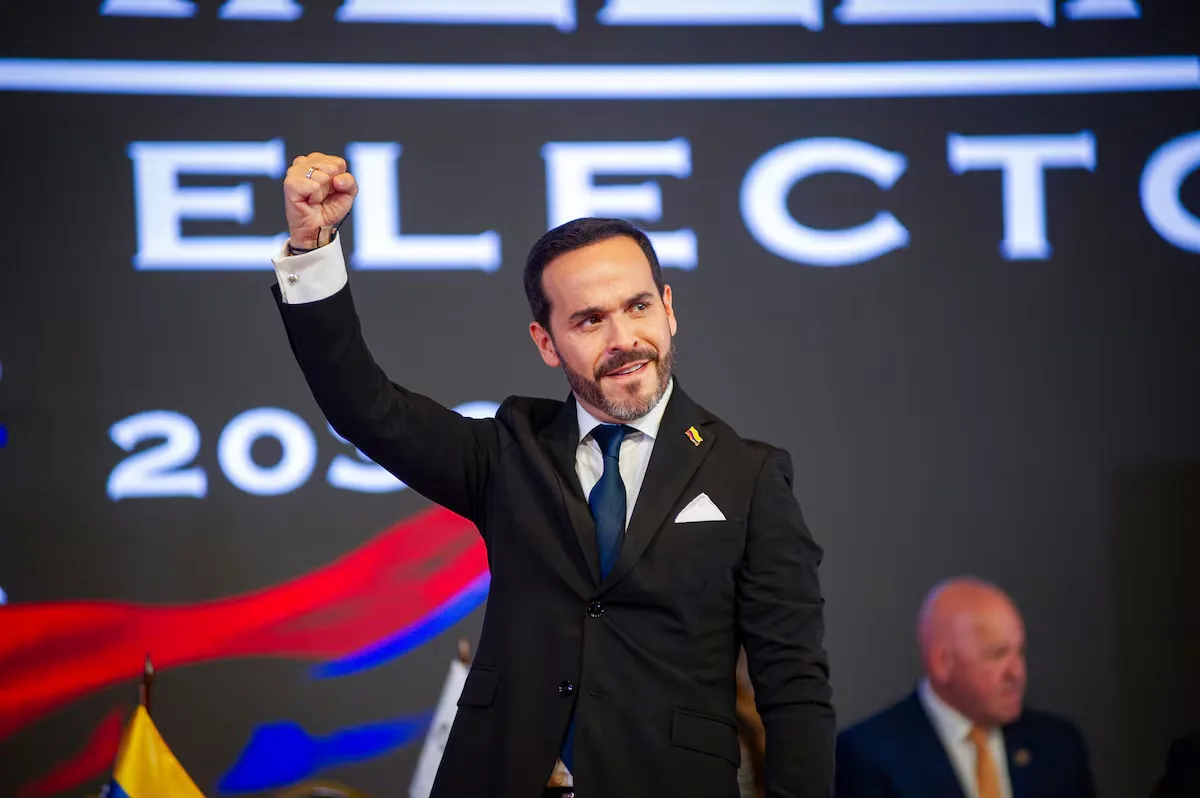








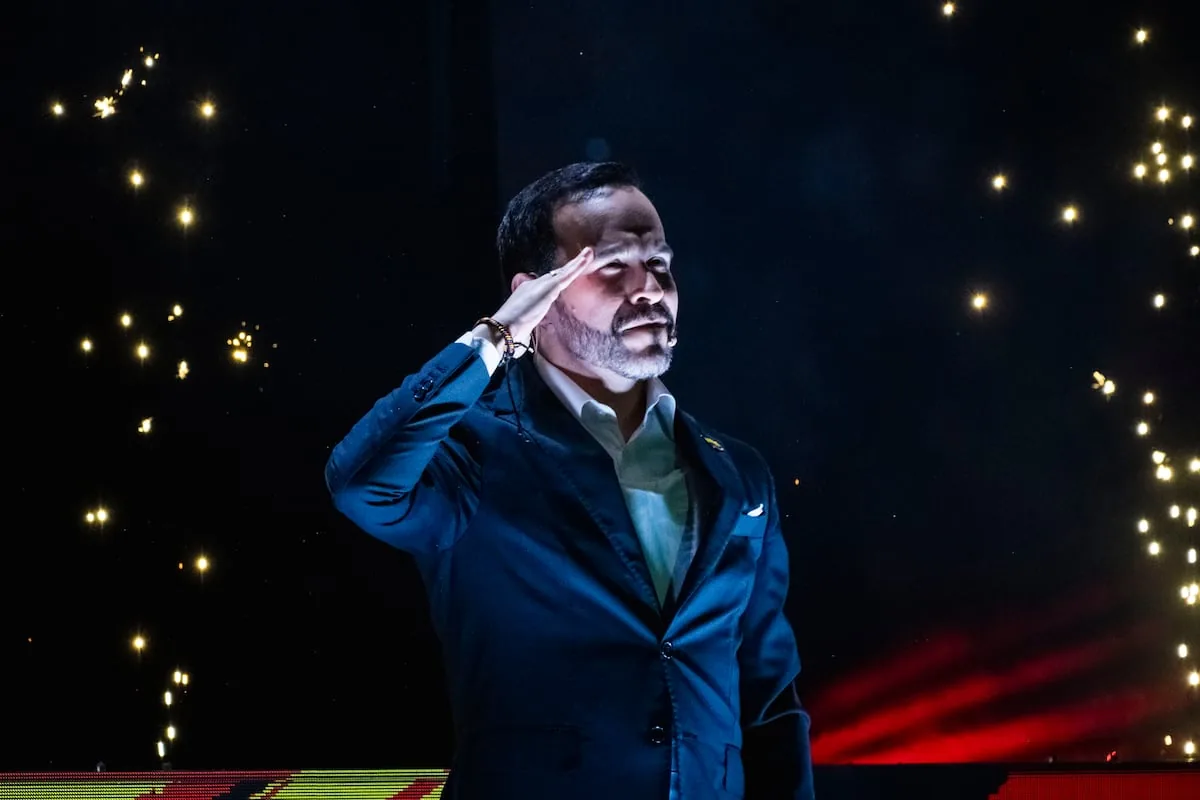
The far-right Abelardo de la Espriella is convinced that his government program is the “path to restore” Colombia, a country that, he maintains, is “going through its darkest hours” during the mandate of the leftist Gustavo Petro. The recipe of the criminal lawyer, who holds a second place in voting intention in most polls, appeals to ideas already proposed by several of his international ultra-right referents, such as the iron fist implemented by Nayib Bukele in El Salvador or the state cut exercised by Javier Milei’s metaphorical chainsaw in Argentina. The outsider candidate appeals to patriotism, security, and the economy in his first 13 proposals to “save the miracle homeland.”
One of the main banners waved by the candidate is patriotism, a principle he believes is at risk due to Petro’s proposal to create a new Political Constitution. De la Espriella proclaims that he will have “absolute loyalty” to the 1991 charter and assures that he will respect institutions. “The Constitution is not an old rag as it has always been treated, nor should it be changed for a communist one,” he says in the 25-minute video in which he presented his proposals. By “the usual suspects,” he refers to traditional politicians, whom he has said he rejects for “living off the state’s teat.”
With patriotism and the “salvation” of Colombia as fundamental lines of his program, De la Espriella addresses several axes. One is security, a concern always present among citizens and which is in the red. His proposal in this area is to cease negotiations with criminals, who “will be taken down as the law dictates.” The iron fist will translate into the promise to build 10 mega-prisons “so that there are no more bandits who remain free and can commit crimes from prisons.” The ultra is a great admirer of the measures implemented by the Salvadoran Nayib Bukele, who, with his strict security policy—object of criticism by civil organizations for its documented human rights violations—has managed to reduce crime in the Central American country.
Internationally, De la Espriella promises to integrate Colombia into the Shield of the Americas, an alliance created by the American Donald Trump with 12 leaders from the region aligned with his ideology. The declared goals of the strategy are to combat drug trafficking and mass immigration, and to reduce China’s influence on the continent. “Colombia will enter and lead this alliance proposed by the US Government to fight decisively against narcoterrorism. Neither Gustavo Petro nor Iván Cepeda [the leftist candidate] have done anything because they are allies of criminals,” the aspirant maintains.
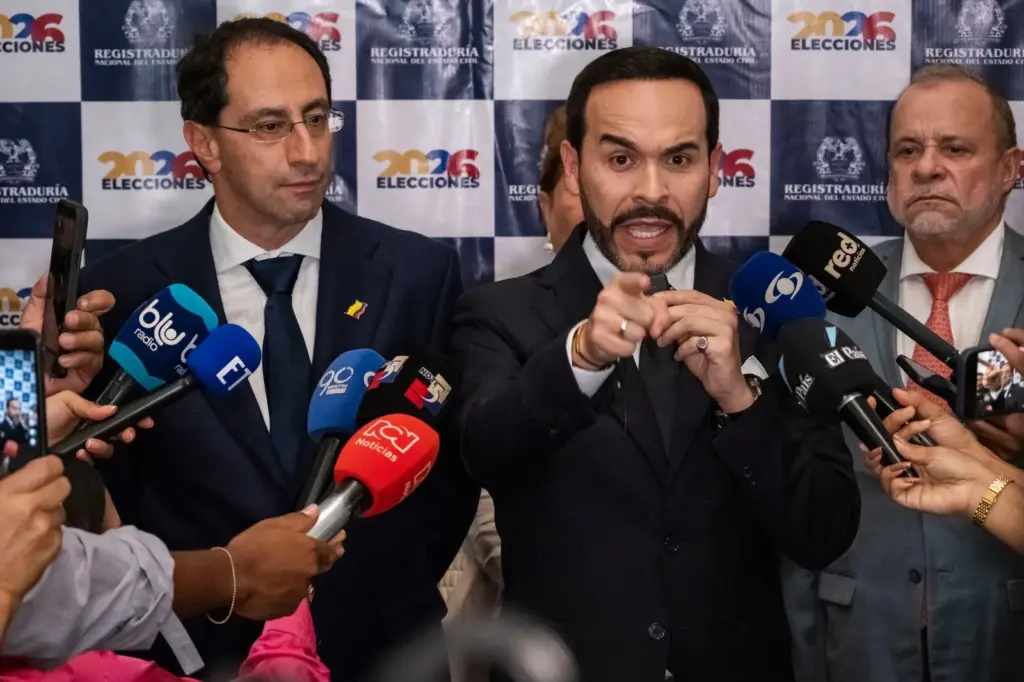
Regarding one of the main issues that have focused the campaign, health, the candidate proposes a shock plan for “the humanitarian crisis faced by millions of patients throughout Colombia.” What he seeks is to restore the flow of resources to an underfunded system that has challenged the Petro government on more than one occasion. The program estimates that redirecting the sector will cost about 10 trillion pesos and that it will be necessary to fight against the corruption “of the usual suspects” in health.
Productivity, at the center
A good part of the proposals resembles a list of business objectives. In education, he wants children to “be trained to be productive, not just to have knowledge, but to become entrepreneurs and wealth generators”; regarding the countryside, he wants to create schools for “rural entrepreneurs” for more than 100,000 young people and expand the productive agricultural frontier.
Read more The government’s commitment to urban peace is diluted without agreements or disarmament
The plan also includes a controversial proposal implemented by the Argentine Javier Milei when he arrived at the Casa Rosada: cutting the state. The symbolic chainsaw reduced the national budget by 30%, mainly affecting education, social development, and infrastructure. Argentina lost 13 ministries and 30,000 public employees. De la Espriella proposes reducing the state by 40%. Although he has not detailed whether he refers to public spending, the state workforce, or the public sector of GDP, if it refers to the national budget, it would mean cutting it from the current 546.9 trillion pesos to 328.1 trillion.
All these measures respond to a larger objective: for Colombia’s GDP to grow by 6% annually, a figure that, not counting the pandemic rebound, the economy has not seen in 15 years. “We will achieve this with a productive policy in agrotechnology, knowledge-based services, sustainable tourism, and renewable energies, recognizing that we cannot fall into the fundamentalism of demonizing mining. We will make a country of owners,” he declared in his video.
His message is reassuring for the hydrocarbon industry, which has remained on the defensive during Petro’s mandate. De la Espriella assures that he can reactivate “responsible exploitation and exploration” while caring for the environment, with safeguards on which he has not given details. In fact, he is explicit that he will remove “absurd regulation” for the industry, which will likely make environmental control more complex.
The program has other isolated proposals. An entire block is dedicated to “the women of the miracle homeland,” where the basis is the reduction of figures of gender-based violence as a “priority public order problem.” The aspirant sets a goal of reducing violence against women by 30% and the number of femicides by 40%—which reached 118 cases in 2025, according to the Ombudsman’s Office—but does not specify how he will achieve these results. Resuming his productive perspective, he also proposes training 150,000 women in digital economy areas and monetizing the care economy, which falls almost entirely on them.
With his program, De la Espriella intends to remodel the state from within through, he maintains, a “corporate government” rather than a political one, which he highlights by believing he can “save” Colombia if the country is managed like a company. It is an approach that Donald Trump has implemented in the United States and whose long-term effects are yet to be seen.