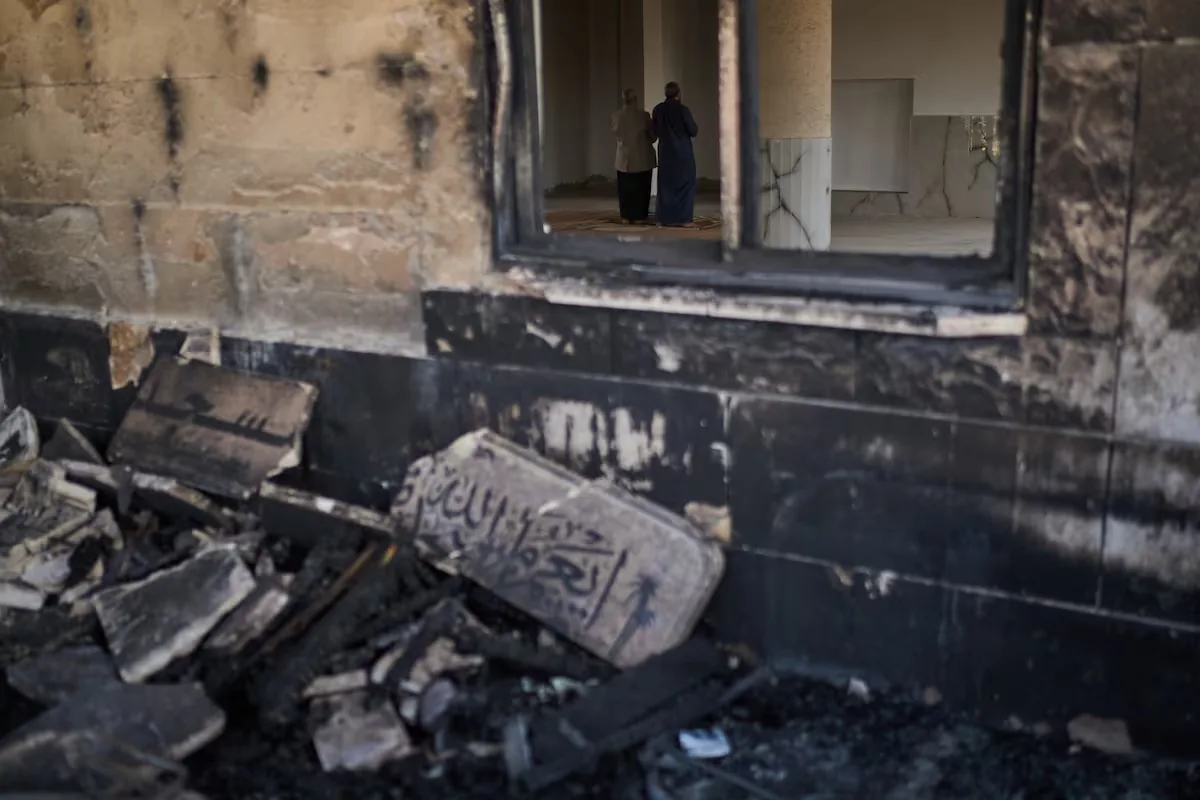









It was exam day at the boys’ school in Al Mugayer, a West Bank town increasingly surrounded by Jewish settlements, when teenage students alerted the younger ones: a group of armed Israeli settlers was coming down from a nearby hill to attack the village. Some dropped to the ground, others ran to their homes, and some mobilized to “defend” Al Mugayer, a euphemism for confronting them with stones. It was not uncommon, but on Tuesday it ended tragically. One of the settlers opened fire from a distance with an automatic weapon (a video captures the moment, as if practicing target shooting) and killed two people. Aws Nasaan, 14, at a spot at the school entrance marked with two bricks, a handful of flowers, and dried blood; and Jihad Abu Naim, one of the adults, 32, who came to confront the settlers. Several recordings capture the chaos and screams during the shooting, with people taking cover and the distant sound of bullets. “I saw the settler: he was shooting at everything that moved,” summarized one of the witnesses, Mohamad Abu Nayi.
Read more Trump’s latest unfulfilled threat in Iran deepens his domestic crisis in the United States
Al Mugayer buried them this Wednesday amidst sadness and resignation: so far this year, deaths in the West Bank from settler shootings (16, according to the Ministry of Health) exceed those for all of 2025, and Israeli justice has not issued a single prison sentence for this in the last decade, despite the constant increase in cases.
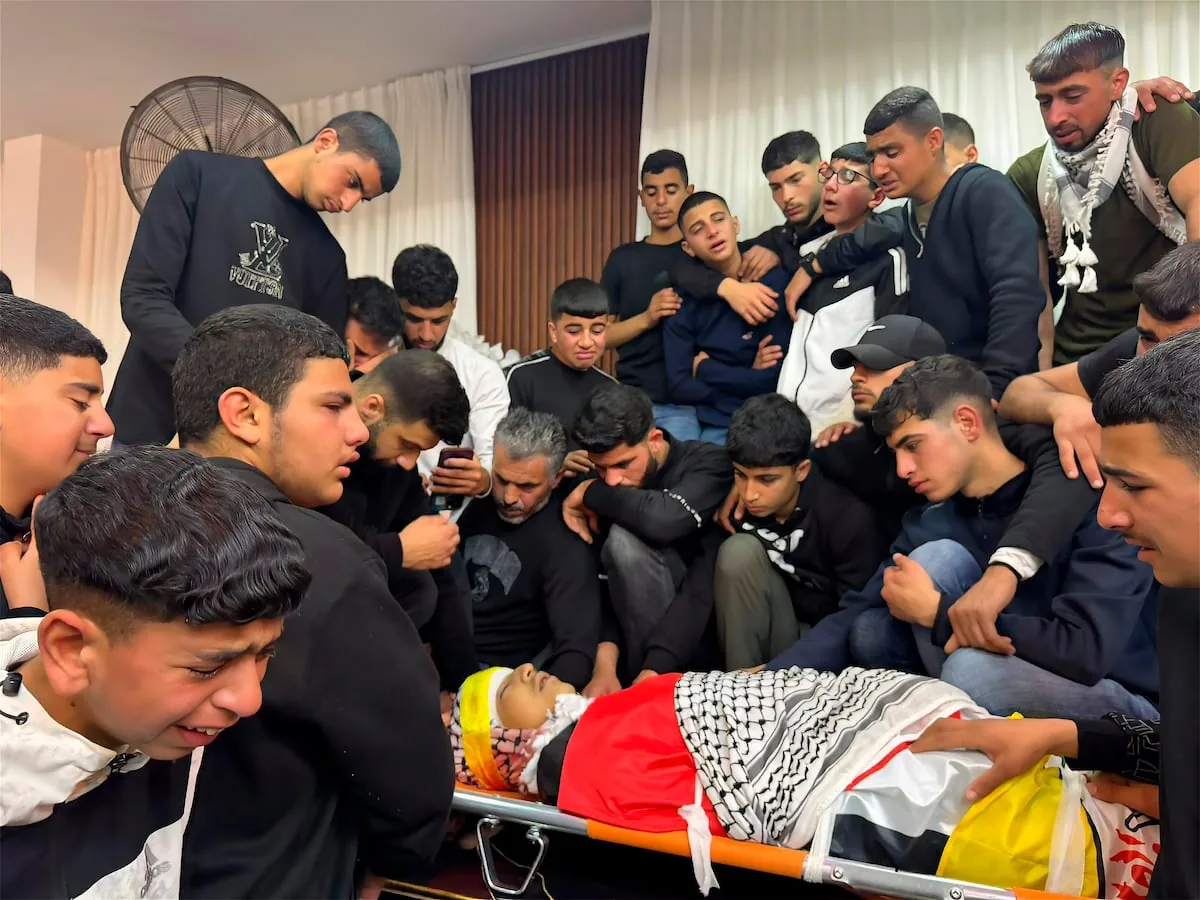
Real Nasaan, 12, was there, in the classroom and facing his exam, when he heard the gunshots in the background. “The teachers got scared and took us out,” he recalls while a crowd of men prays in the community hall courtyard. “Half the students fled one way and the other half, the other. There was an emergency door. We went out through it, and I was scared […] Aws was outside and he was shot.”
Aws and his three siblings grew up with their grandparents. His father, Hamdi, died (also from settler gunfire) in 2019, and his mother remarried and moved to the United States. That’s why Taleb Nasaan, his 73-year-old grandfather, is today receiving hundreds of condolences and steps aside to regretfully recount that he woke the boy “up to three times” to go to school precisely on the day of the tragedy.
From the frustration of the inevitable, he also scolds him for having left school when the shots rang out, instead of obeying the teachers and staying inside, lying down. “He didn’t listen, he was stubborn, he got up, went out, and was shot directly in the head […] He’s young, he doesn’t understand what’s happening. What danger did he pose to Israel or its government?” protests Taleb, who in just seven years has lost a son and now a grandson, at the hands of radical settlers who are increasingly imposing their law in the West Bank. “I cried once for my son, but ten times for my grandson,” he concludes.
A Repeated Ritual
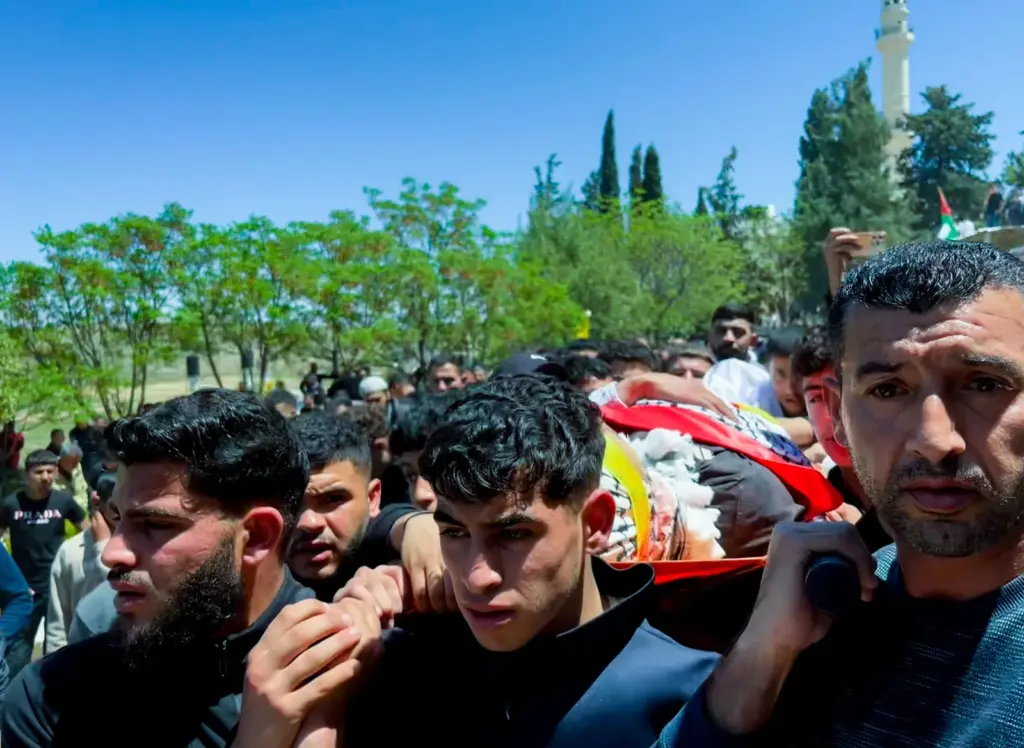
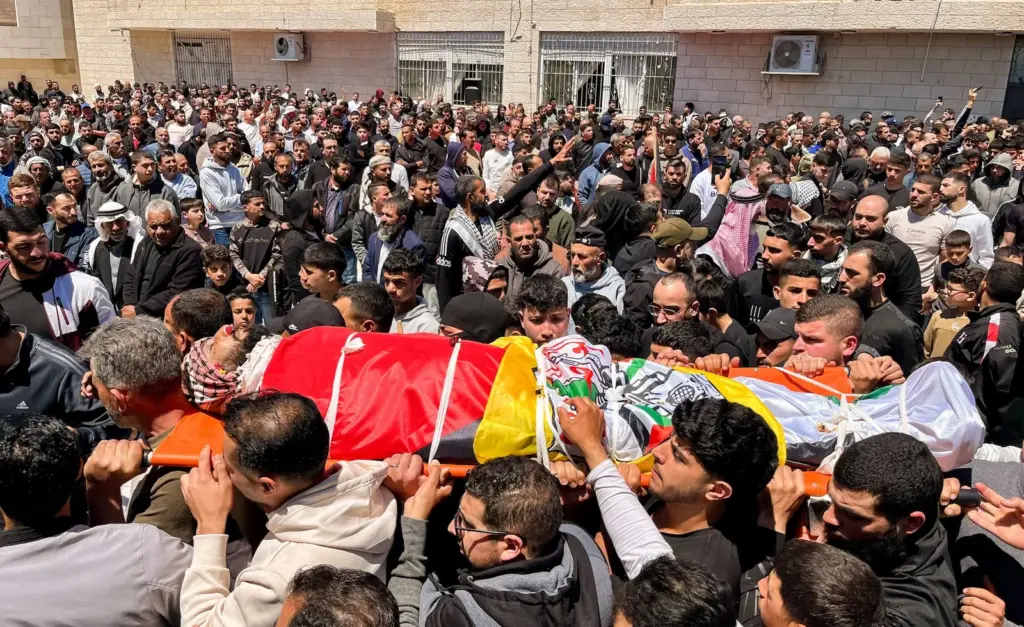
At noon, the village once again performed the ritual, repeated more than a thousand times throughout the West Bank in the last two and a half years: first, a collective Muslim prayer in front of the bodies; then, their transfer to the cemetery amidst solemn faces, some shots fired into the air, and chants like “With our blood and our soul, we will avenge the martyr,” the title given here to those who die in the context of the conflict with Israel, whether as mere victims or while launching an attack.
Up on the rooftops, women threw flower petals as the bodies passed. Below, young people struggled to touch their faces, as a last farewell and considering them pure. Some teenagers had their faces covered to try to evade the advanced facial recognition and artificial intelligence technologies used by Israeli intelligence services.
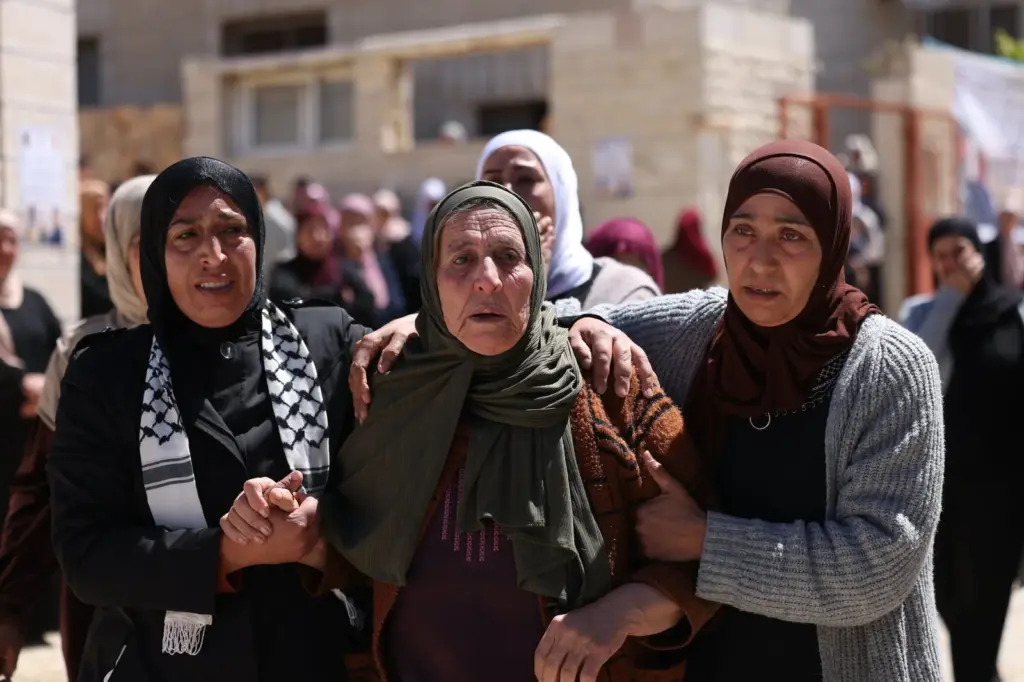
Al Mugayer, with about 3,500 inhabitants, is traditionally linked to Fatah, the party of Palestinian National Authority President Mahmoud Abbas. This is evident in the yellow flags accompanying the funeral procession and in the martyrs’ posters. Nasaan’s poster has a particularity: it says “martyr son of martyr” and includes his photo, barely nine years old, mourning his father.
Abu Nayi, 16, has just lost his uncle Jihad and seems to struggle throughout the conversation to hold back tears. 24 hours ago, they were together during the settlers’ attack, and a few minutes ago they parted forever in the cemetery. He recounts that he was at school when the shooting started and saw other “students lying on the ground,” but he went up a hill with 15 other people to get a better look at what the settlers were doing, “to confront them and try to push them back as much as possible.”
Jihad was at the front. “We called him and told him to go back, that they were going to shoot him, but he didn’t listen to us,” says Abu Nayi. “When he turned around and decided to return, he was shot in the back. The bullet entered from behind and exited through his heart. I was nearby, screaming and asking for help and an ambulance. Then the young people arrived, we carried him and fled with him.” A private car took him to the village clinic, where they could not save his life.
Read more Ariadna Montiel: the discreet operator of the 4T social programs
Testimonies indicate that there were five or six settlers, mostly dressed in civilian clothes and some unarmed. Also, that only one fired the lethal shots. Two still-fresh Arabic graffiti today recall this in the streets of Al Mugayer: “Revenge for the martyrs” and “Murderer, you will die.”
Reservist Soldier
When consulted, the Israeli army stated that the suspect was mobilized as a reservist soldier within one of the West Bank brigades that draw from settlement residents, and that, following the massive mobilization since the Hamas attack and the invasion of Gaza in 2023, more and more Palestinians are encountering violent old acquaintances, but now transformed into military authority, with a uniform and an automatic weapon in their hands.
The army also specified that the military prosecutor’s office has opened an internal investigation and has suspended him from service pending resolution, but he has not been arrested. In the video that captures him continuously opening fire on civilians, he is alone (no comrades around) and in military trousers, but without the rest of the uniform.
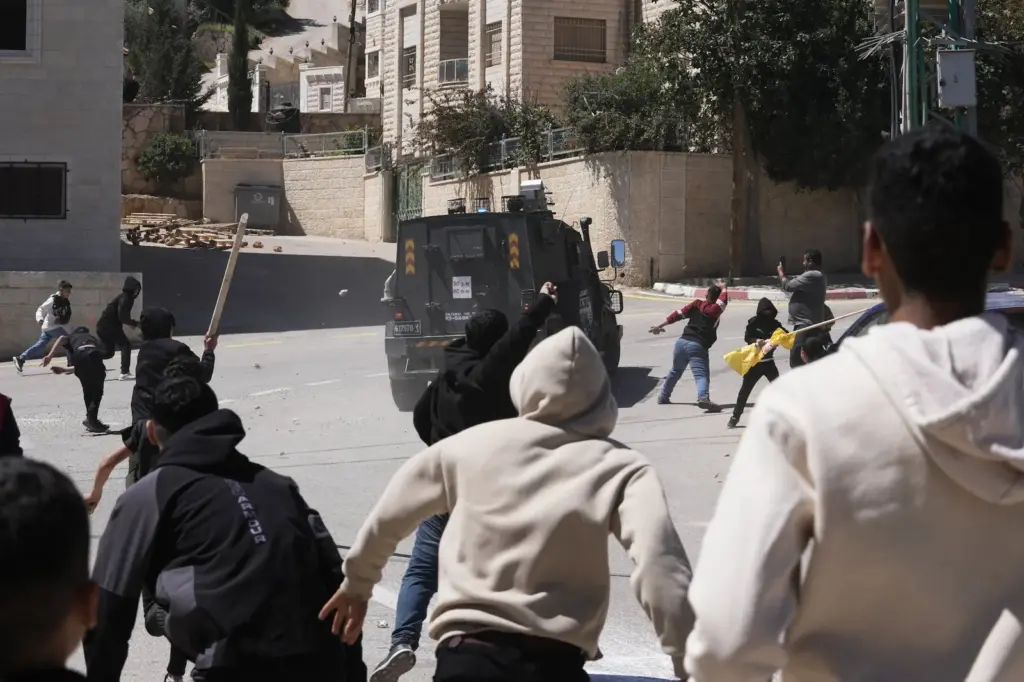
On Tuesday, when the army arrived in Al Mugayer, they fired tear gas, locals complain. On Wednesday, they did it again. In the mid-afternoon, two young Israeli soldiers could be seen laughing as they fired more tear gas and stun grenades into almost empty streets, as if it were a game. A group of Palestinians of similar age grabbed stones to throw at them and then ran away.
Al Mugayer is one of the West Bank localities that has been suffering the most violence. Settler attacks continue to grow and have become daily, whether in the form of harassment, car burning, or cattle theft, explains the president of the local council, Amin Abu Alia. The locality is already surrounded by eight small settlements. They flourish with every blink, thanks to the unprecedented weight of the far-right in colonization given by Prime Minister Benjamin Netanyahu.
The village is almost 30 kilometers from the city of Ramallah, in an area targeted by the most radical settlers and their political partners: it is key to cutting off the territorial contiguity of the West Bank and depopulating areas that do not include large cities. That is, to —as its main representative, the ultranationalist Finance Minister Bezalel Smotrich, boasts— change the reality on the ground to “make the idea of a Palestinian state impossible.”
The Israeli army also chose its olive groves for a collective punishment with an instructive purpose. Last August, information began circulating that a resident of Al Mugayer had attacked a settler. The army imposed a curfew, with three days of raids and arrests, and ended up uprooting 10,700 olive trees, some a century old, according to local authorities.
The Israeli military commander in charge of the area, Avi Bluth, did not hide the motivation: “Every village must know that if it commits an attack, it will pay a high price and will be under curfew and surrounded. Uprooting the trees was intended to deter everyone. Not just this village, but anyone who tries to raise a hand against [Jewish] residents.” The army later denied it: there was no intention of retaliation, only to “clear” the olive grove through which the alleged perpetrator of the attack fled. Today it is a huge green plain without trees.
Read more The death of two CIA agents in Mexico raises alarm over U.S. interference