








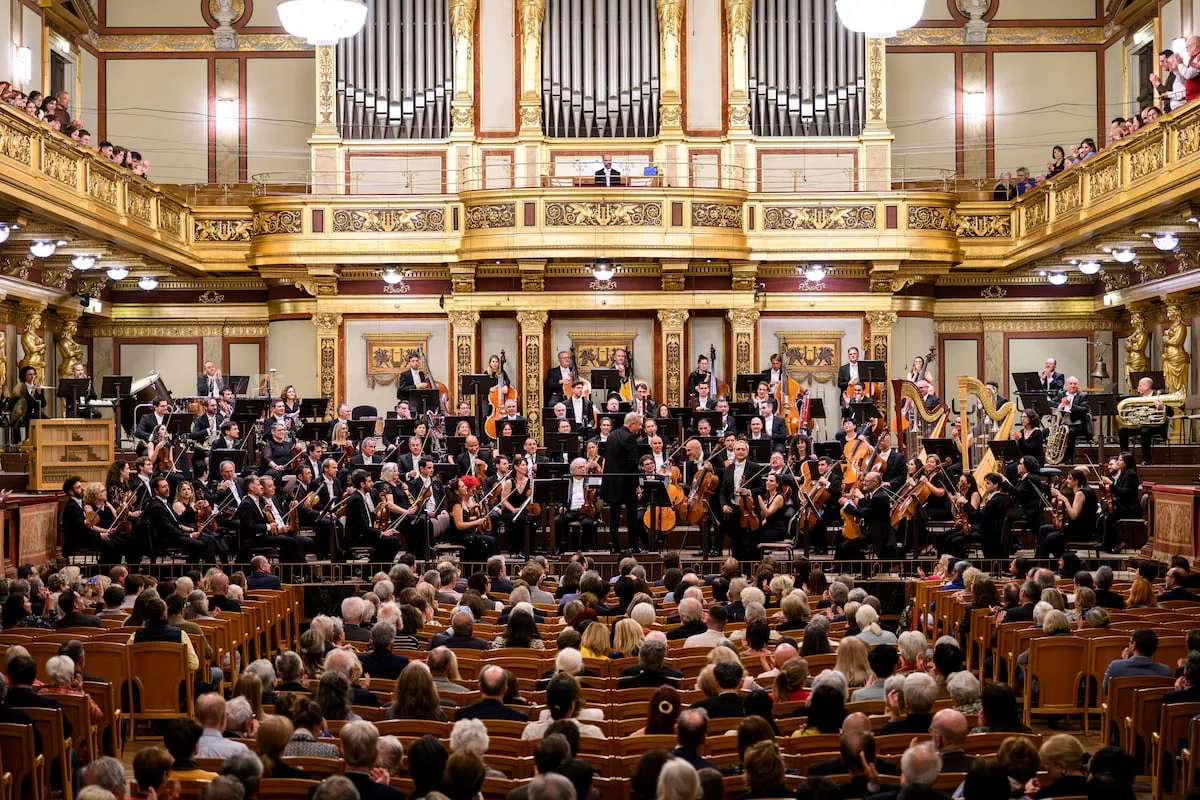
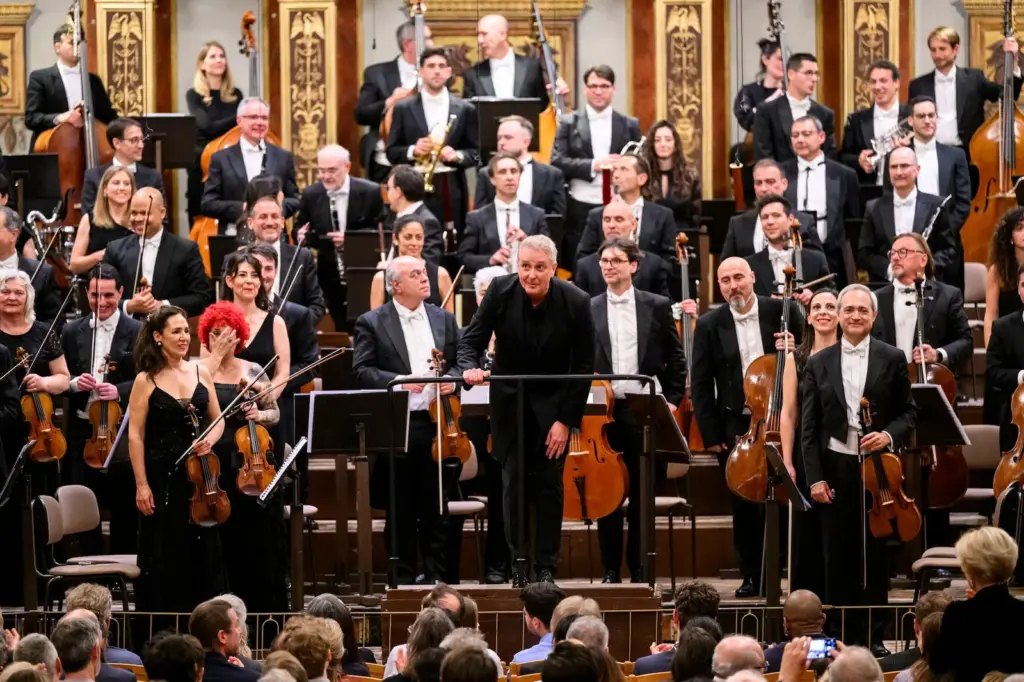
The musicians of the Valencia Orchestra (OV) were hugging and congratulating each other at the end of the concert. They looked ecstatic and relieved. They had just debuted on one of the most legendary stages in the world of classical music, the Golden Hall of the Musikverein in Vienna, where the city’s Philharmonic celebrates the traditional New Year’s Concert. And the experienced audience gave them intense applause, which prompted an encore, during the eclectic program offered this Thursday, which had a little bit of everything, starting with the overture of The Tree of Diana from the opera that the Valencian composer Vicente Martín y Soler, known as the Spanish Mozart, premiered in October 1787 in the capital of the then Habsburg Empire.
Read more The 65 recommendations from Quadern critics for Sant Jordi 2026
“History weighs, but the music flows,” said a satisfied Alexander Liebreich, the German principal conductor of the ensemble, after stepping down from the podium where the best conductors in history have led. “The acoustics are perfect, it’s like the house of music,” he added, amid congratulations from various people.
An opinion shared by the performers, although the double bass players had to adjust to the limited stage space and the proximity of the wall and the organ that participated in the always impactful Thus Spoke Zarathustra by Richard Strauss, the popular symphonic poem with which the concert, part of the Jeunesse–Musikalische Jugend Österreichs (Musical Youth of Austria) cycle, concluded, an event to which the Valencian ensemble was invited to participate. “From here, it’s amazing how the sound projects and how the music envelops you in the hall,” commented one performer.
The audience filled about two-thirds of the rectangular and ornate golden hall, decorated with paintings on the high ceilings and caryatids serving as columns, inaugurated in 1870 by Emperor Franz Joseph. At the same time, the auditorium offered another chamber music concert in an adjacent room, which also had a good turnout. And not far away, at the Konzerthaus, Simon Rattle was conducting the Vienna Philharmonic, the Musikverein’s resident orchestra, that same Thursday afternoon. The musical and cultural offerings, in general, of the Austrian capital seem boundless.
The audience especially applauded the original effort of two pianist brothers, the Israeli Berlin-based Sivan Silver and Gil Garburg, who played a four-hand adaptation for orchestra by Richard Dünser of Brahms’ Piano Quartet No. 3, a piece that did not convince part of the critics at its premiere in Valencia last week, but which this Thursday was ovationed to the point that the artists gave an encore in the form of a scherzo by Rachmaninov.
The ninth international outing of the Valencia orchestra, which, like other Spanish ensembles, seeks to project itself beyond its usual domains and showcase improvement in repertoire and quality, also featured the performance of the impressionist and exuberant second suite from the ballet Daphnis and Chloe by Ravel, which was also very well received.
Being a Valencian orchestra, the choice of Martín y Soler (Valencia, 1754-Saint Petersburg, 1806) in the program seemed obvious and, above all, in a city like Vienna, where he triumphed 240 years ago, although the pleasure of listening was short due to the duration of the opera overture.
The Tree of Diana was developed alongside Mozart’s Don Giovanni, which premiered shortly after, and both works share the same librettist: Lorenzo Da Ponte. “More than 200 years later, the orchestra from his hometown returns to play Martín y Soler, to perform his work here, where it was premiered,” highlighted María Rubio Navarro, principal horn of the OV. “Usually, when Spanish orchestras go abroad, we are asked for Spanish music: Falla, Albéniz… And we never show what came before that,” the artist claimed before performing. Martín y Soler’s fame in Vienna at times eclipsed that of Mozart himself, although the two musicians admired and inspired each other.
José Luis Moreno, Councilor for Cultural Action and president of the Palau de la Música de Valencia, where the OV is based, emphasized the importance of promoting the “Valencia brand” and the city’s culture through the trip organized by the City Council, which also included journalists from various media. “It is very important for orchestras and musicians to leave that comfort zone and go abroad for two reasons: they feel more valued and, above all, to make the music known, in this case Valencian and Spanish,” he said, also in statements to Efe, before the concert began.