





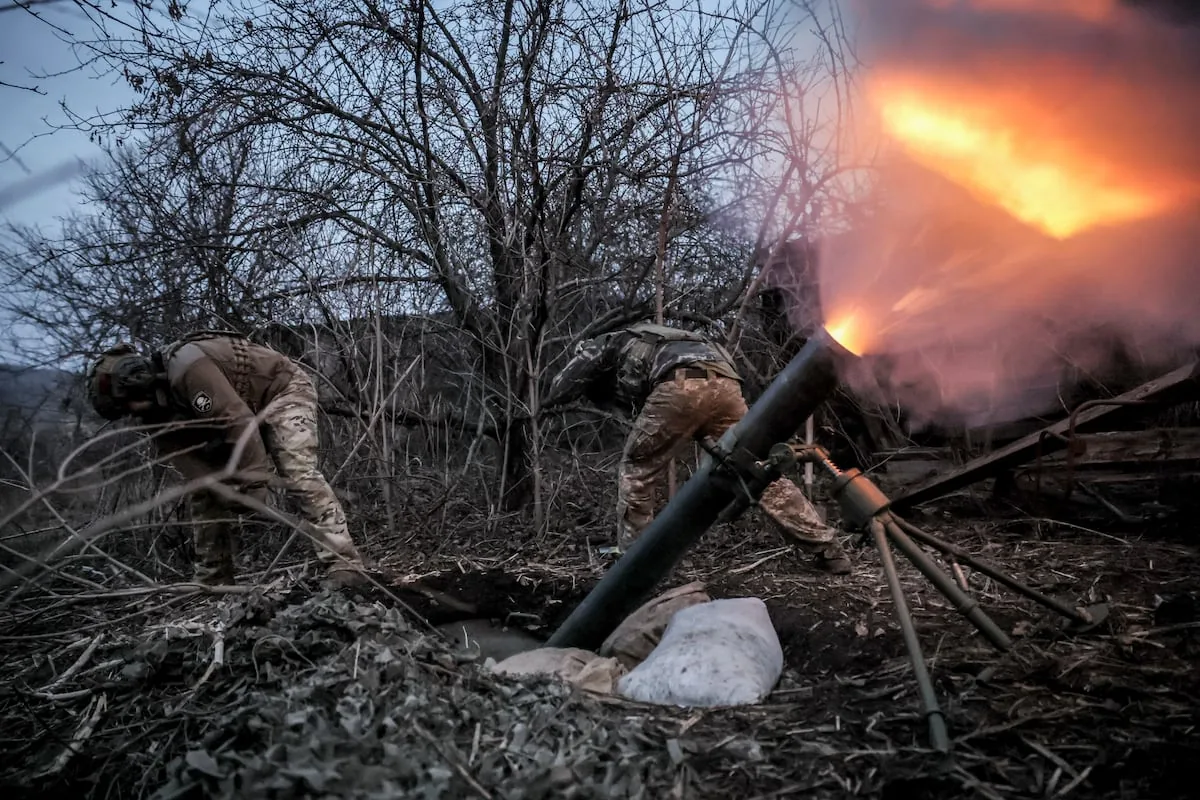
Ukraine will carry out the first phase of demobilization of soldiers in 2026. The military leadership had so far ruled out this possibility arguing that if the Ukrainian Armed Forces lacked anything, it was troops. But the situation has changed: partly because drones increasingly replace human sacrifice; also due to pressure from civil society demanding that soldiers who have been active since 2022, since the start of the war, return home. Ukrainian President Volodymyr Zelensky announced this Friday that this year the first combatants will be able to leave the army.
Read more 60 days of conflict: Trump’s war in Iran is now as unpopular as Vietnam’s
Sources from the Ukrainian president’s office have indicated that the idea is for the beneficiaries of this first demobilization to be soldiers who voluntarily joined the army in 2022, at the start of the invasion. Around half a million civilians volunteered to defend the country at the beginning of the war. The recruitment of volunteers stopped abruptly at the end of 2023, when the great Ukrainian counteroffensive of that year failed.
Until now, returning to civilian life has only been possible in rare exceptions, such as those who have suffered serious injuries or have a direct family member who is dependent due to illness. Zelensky has reported that this demobilization will depend on the results of a deep reform in the recruitment system that will come into effect in June. The priority will now be to recruit new soldiers not through compulsory conscription but as contracted personnel with a fixed service period.
This period, according to current standard contracts, usually ranges between three and five years. Once the contract is finished, the person can return to civilian life for at least one year, although martial law includes causes that may require them to continue in the army.
In 2024, there was already an intense parliamentary debate in Ukraine to approve a demobilization law, but both the president’s office and the military leadership advised against it because they considered it impossible to reduce the troops. The Ukrainian army is composed of more than 800,000 people.
Defense Minister Mykhailo Fedorov stated last January, upon taking office, that recruitment was one of the biggest problems to face. Fedorov specified that at least two million men are hiding from compulsory enlistment and that 200,000 soldiers have deserted.
Vadim Sujarevski, deputy commander of the Ukrainian forces for the east, warned on April 18 in an interview with EL PAÍS that the only way to solve the lack of troops is by establishing a time limit for military service: “Everyone should know how long they will be at war. It is a huge problem for our soldiers, especially for those who started fighting voluntarily at the beginning and are still fighting today; psychologically it is tough. When we specify to our people how long they will fight, recruitment will improve.”
Sujarevski also emphasized that Ukraine’s commitment to drones has allowed reducing the number of soldiers required on the war front. The fact that control of the front is mainly carried out with these devices means that Ukrainian infantry is up to five times smaller than what would be necessary in a conventional war.
Read more US blockade saturates Iran’s oil deposits and threatens to shut down wells
The reforms proposed by Zelensky also aim to encourage the recruitment of people into the infantry. The regiments fighting on the front suffer the greatest need for replacements and have the fewest candidates because it is the most dangerous and hardest job in the war.
The commander-in-chief of the Ukrainian Armed Forces, Oleksander Syrskyi, signed an order this Thursday raising from two weeks to two months the maximum time a soldier can be without rest on the front line.
The lack of personnel is causing it to be common for a soldier to serve in the trenches for months, which seriously harms mental and physical health. A report from the Ministry of Defense published this week concludes that being on the front fighting for more than 40 days “leads the soldier to lose morale to the point that they do not care whether they survive or not.”
Salary increase
Fedorov has emphasized that the upcoming changes must establish “a clear rotation system.” The current situation is so complex that there are even cases of soldiers having to remain in the trenches for a year. To correct this situation and attract personnel to the infantry, Zelensky has announced a salary increase in the army.
All ranks will see an increase: those in the rear will earn a minimum of 580 euros per month (compared to the current 400 euros). But it is for those carrying out combat missions on the front line where the salary jump is greater, at least double: if the current range is between 2,300 and 4,000 euros, according to official data from the Ministry of Defense in 2024, it will now be from 4,800 to 7,700 euros.
“Those who wanted to volunteer for the army, like me, have already done so,” battalion commander Taras Mykhalchuk explained to this newspaper in 2024. The way to reverse the lack of troops, predicted this veteran officer, was economic motivation: “Remuneration must be raised, from salaries to compensation for being wounded. It is the best solution.”
A spokesperson for Zelensky has commented that the government is still studying how it will finance this huge increase in military salaries. Zelensky stressed last week that he will allocate the first tranche of the 90 billion euro loan that the European Union approved on April 23 for Ukraine to the army.
Read more ‘Medea’ and ‘Feos’: stories of three unfortunate people to whom everything is an enemy