









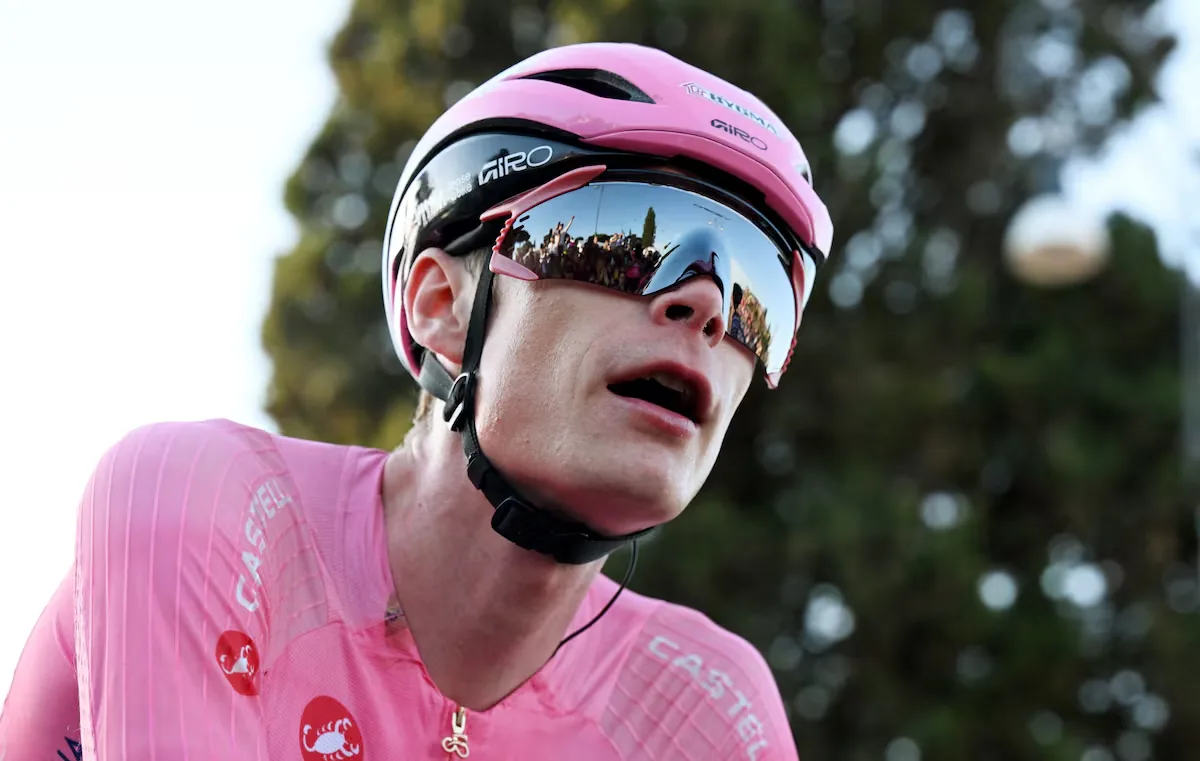
Twenty-one days later, the story has ended. Jonas Vingegaard arrives in Rome and the city celebrates, arms open and spirits to the sky to welcome the new Giro d’Italia champion. Dressed in pink since May 23, when he shook the tree in the Aosta Valley, the Dane smiles in the Eternal City and finally becomes the winner of the three grand tours: the Tour de France (2022 and 2023), the Vuelta a España (2025), and the Giro d’Italia (2026). Only seven cyclists had achieved this before: Jacques Anquetil, Felice Gimondi, Eddy Merckx, Bernard Hinault, Alberto Contador, Vincenzo Nibali, and Chris Froome, the last to close the circle in 2018, also in pink and also near the Colosseum.
Eight years later, Vingegaard, shy grimace next to his wife and children, is pleased to rewrite history. He does so leaving no room for surprise. The Visma leader, who will turn thirty at the end of this season, crosses the final Giro finish line at the imposing Circus Maximus with five stage wins — more than in any of his previous grand tours — and a large time gap over his two immediate pursuers in the general classification, Felix Gall (5m22s) and Jai Hindley (6m25s), both exceptional companions on the final podium.
Neither one nor the other, nor any participant in this Giro, was able to challenge the overwhelming superiority of the graceful Danish champion over three weeks. With Pogacar flexing his muscles on the long climbs of Sierra Nevada, where most riders with a date in the next Tour de France gather these days under the sun, Vingegaard meets the heavy expectations in Italy and can finally breathe easy. He also celebrates by raising the stakes of the Slovenian ogre, who has already popped champagne in Paris (2020, 2021, 2024, and 2025) and in Rome (2024), but not yet in the streets of Madrid. “It’s a matter of time before he also wins the three grands,” admits the Visma leader, the only one capable of knocking out Pogacar in the high mountains. “Tadej is probably the best cyclist of all time.”
🩷 Family. #GirodItalia pic.twitter.com/4xdpTnqhLV
— Giro d’Italia (@giroditalia) May 31, 2026
Vingegaard’s performance is no less impressive, a brilliant grand tour specialist and as consistent as few can remember in recent history. The Dane was 46th in his first grand tour, the 2020 Vuelta, compressed into autumn due to the pandemic, and since then he has never left the top two podium spots in five editions of the Tour, two of the Vuelta, and one of the Giro: 2nd, 1st, 1st, 2nd, 2nd, 2nd, 1st, and 1st.
The Italian race has not repeated a winner since 1993, when Miguel Induráin donned his second maglia rosa, then in Milan. Since then, countless riders, alternating between great and unexpected champions, have lifted the coveted Senza Fine trophy. This time the route of the recently concluded edition does not help, monotonous, lacking the most emblematic climbs of what is called the most brutal and ruthless race on the calendar, and without fireworks among the favorites — for the first time in history, the top three in the general classification, Vingegaard, Gall, and Hindley, matched the order of arrival in four different stages. The Dane, the strongest from start to finish, is the final winner. Logic prevails.
Read more Spanish rugby legitimizes its stronghold in Valladolid in the World Sevens Series
🔻 One final sprint. Fast, and definitely furious
🔻 L’ultimo sprint profuma di rivincita e di liberazione.
⏪ The @continentaltire Ultimo Kilometro#GirodItalia pic.twitter.com/vn1kk4uKoB
— Giro d’Italia (@giroditalia) May 31, 2026
The question remains how far the Dane has pushed himself, whose directors trust in an increase in performance at the Tour, the second grand tour on his agenda. Vingegaard’s face does not alter the uncertainty, calm from the last ribbon cut to raising his arms in the imperial forums of Rome. Ahead finally flies the Italian Jonathan Milan, a powerful sprinter overshadowed throughout the race by Paul Magnier’s dominance.
The Italian anthem sounds and so the Giro says goodbye, another May gone. Everyone returns home, the barriers are stacked on the way back to the organization’s trucks, and the bottles dropped during the race are now lovingly displayed on fans’ shelves. It seemed it would never end, and now it’s a thing of the past. Today, the talk is about something else. About the women’s edition, underway since Saturday, the Tour de France (can Seixas really disrupt the established order?), and what the future holds. Such is life. Such is the relentless wheel of current cycling.
Read more Paloma Valencia’s campaign: the Uribista who declares herself against the extremes
| pos rider | Team | Time |
|---|---|---|
1
| LTK | 3h:05:50 |
| 2
| EOK | +00:00 |
3
| CGF | +00:00 |
4
| TDT | +00:00 |
5
| EFE | +00:00 |
6
| DCD | +00:00 |
7
| APT | +00:00 |
8
| NSN | +00:00 |
9
| LOI | +00:00 |
| 10
| TUD | +00:00 |
| pos rider | Team | Time |
|---|---|---|
| 1
| TVL | 83h:22:51 |
2
| DCD | +05:22 |
| 3
| RBH | +06:25 |
| 4
| IGD | +07:02 |
5
| LTK | +07:56 |
6
| TBV | +09:39 |
| 7
| TUD | +10:13 |
| 8
| TVL | +10:52 |
| 9
| TBV | +11:24 |
10
| IGD | +12:54 |
See full classification
19 
Feltre – Alleghe

Sepp Kuss
TVL
151 Km
Fri 29-May
20 Gemona del Friuli – Piancavallo
Jonas Vingegaard Rasmussen
TVL
200 Km
Sat 30-May
21 
Rome – Rome
Jonathan Milan
LTK
131 Km
Sun 31-May