






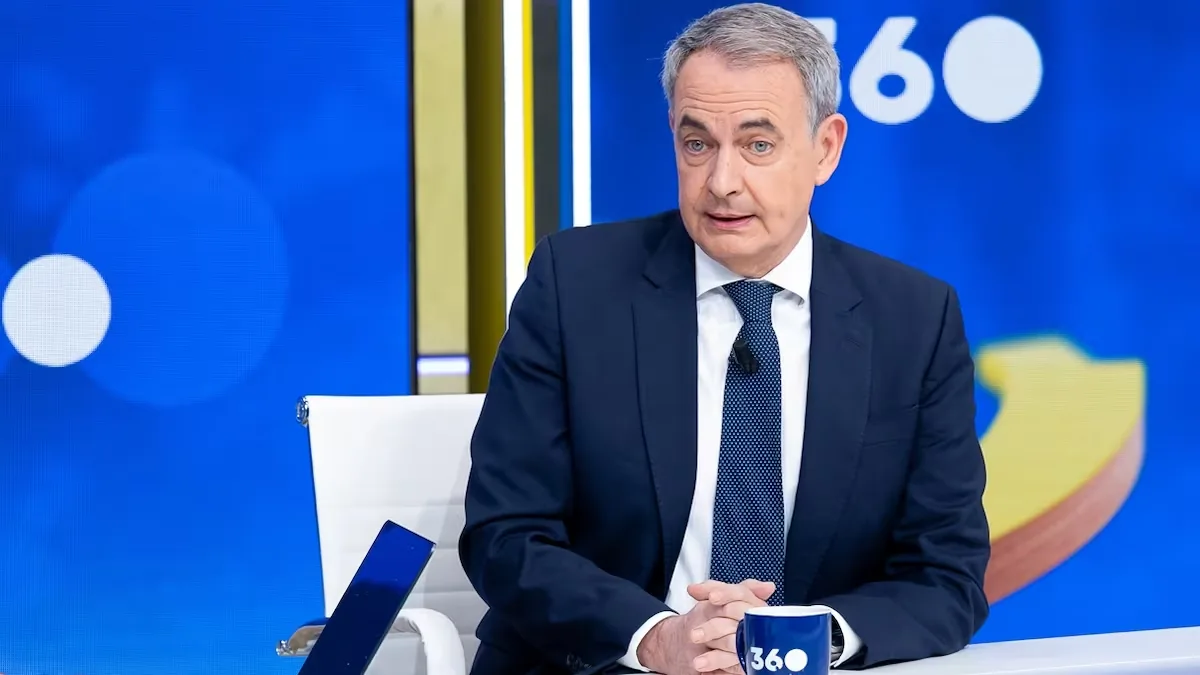
José Luis Rodríguez Zapatero’s first interview —on TVE’s Mañaneros program— since the Audiencia Nacional charged him with leading a scheme of illicit influence peddling, has yielded few new legal developments despite the enormous political expectation generated, especially due to the discomfort his silence caused within the PSOE. The former President of the Government himself admitted during his intervention that, after two months without public explanations – beyond a brief video released to declare his innocence – a “parallel problem” has been added to his delicate situation with justice: his “need” to give explanations because friends and party colleagues are demanding them. Under this premise, he focused on publicly reiterating what he had already maintained behind closed doors before Judge José Luis Calama when he testified as a suspect on June 17: that he neither intervened in the rescue of Plus Ultra, nor planned the creation of an offshore company to camouflage his income, nor used his daughters as straw persons.
Read more Calls to 016 grew by 120.8% in the hours after Spain won the World Cup
The only new information he provided was about the jewels found in his office, supposedly valued at over 1.3 million, about which he has not yet testified before the judge. According to Zapatero, they were a “courtesy gift” whose origin he did not want to reveal, but with which he did not seek a “patrimonial increase”. Although he did admit that perhaps it was a mistake to accept them.
On the day marking 26 years since his unexpected victory in the primaries that led him to the general secretariat of the PSOE, an anniversary he himself made sure to recall, Zapatero has strived to defend his innocence and has complained on several occasions that very serious unfounded allegations are being attributed to him and his family. “Accusations must be proven,” said the former leader, visibly tense during some moments of the interview, in which he complained about the leaking of his diaries and personal conversations with his secretary, Gertrudis Alcázar. “This has never happened. My right to privacy has been affected. It will have to have consequences […] I don’t judge anyone’s intentions, but the rules are what they are, and all the rights affected by these leaks are those highly protected by the Constitution,” he stated.
His televised intervention comes 48 hours after the testimony as a suspect of his friend Julio Martínez Martínez, administrator of the company at the epicenter of the investigation —Análisis Relevante— who pointed to the former leader as the person “who set the steps to follow” in the rescue of Plus Ultra. Zapatero denied it: “I did not speak with anyone from SEPI or the Government, nor with any public authority. It’s not that I didn’t influence, it’s that I didn’t speak with anyone about the Plus Ultra rescue,” said the former president, who denies the crime of influence peddling that the judge attributes to him. For this crime to exist, according to the Penal Code, it is not necessary for that influence to have been effectively exercised; it is enough for someone to have offered to influence in exchange for “gifts, presents, or any other remuneration” or to have accepted that “offer or promise”. In addition to influence peddling, the investigating judge considers that the scheme in which Zapatero allegedly participated incurred crimes of criminal organization, misappropriation, document forgery, money laundering, smuggling, and against the Public Treasury.
The former president did not want to delve into what Martínez Martínez declared before the judge, nor into the document he submitted on Monday to the Audiencia Nacional, in which he placed the former President of the Government as the mastermind behind that and all operations in which Análisis Relevante participated. “I am not going to enter into the defense strategy of any accused person. I defend myself and reiterate my statements about my null role in the Plus Ultra rescue,” affirmed the former socialist leader, who also vehemently denied that, as the judge and the Police maintain, he devised the creation of an offshore company to divert money obtained through illicit influence peddling. This suspicion, one of the pieces of evidence on which investigators base the accusation of tax fraud against the former president, is, according to Zapatero, “an absolute invention or an error”. “But it is an element of charge that is imputed to me. The facts are what they are, and whoever accuses must prove it,” he lamented again.
Zapatero insisted on positioning himself as a mere external consultant for the company and denied having irregularly profited from his political contacts. “It is evident that the clients of that consultancy could understand that I was the consultant, but all my work was advisory, consulting. I never intended to, nor did I participate in any company, nor did I sign any contract with any client,” assured Zapatero, who explained that Martínez Martínez and other partners (Sergio Sánchez, a friend of the former president) formed the company, and he “accepted” to be a consultant. “I find it normal to receive remuneration for that work,” said the former president, who maintains that all his work is declared in the IRPF tax. “I will prove it,” he said.
Read more Earthquakes in Venezuela caused damage valued at 19.6 billion dollars, according to the World Bank
Nor is it true, he states, that he warned Martínez Martínez and those responsible for Plus Ultra that SEPI was going to grant the rescue to the company 11 days before the aid was approved. “I deny it. I didn’t know what SEPI’s board was going to do. I didn’t intervene in anything, I didn’t know, and that’s the truth. From there, [Martínez Martínez], in his right to defense, can argue whatever he wants,” he reiterated, referring to what his friend declared, whom he did not want to disown after he pointed him out to justice. “It’s a friendship of many years, and it doesn’t align with my code of conduct. One must separate relationships from judicial proceedings; it’s not in my nature to deny having had a long-standing friendship with him.”
The former leader does admit that he called the vice president of Banco Santander, Juan Manuel Cendoya, to ask him to meet with the airline’s executives, who were seeking access to an ICO loan before the public rescue began to be processed. According to Zapatero, what he did was “simply facilitate a contact”. “I called that executive [from Santander] to see if he could receive some people. I get requests of that type every day. Even today. We’re going to reach the point of madness where calling someone, meeting with someone, is exercising influence,” he lamented. That is the only action in favor of the airline that Zapatero claims to have taken, denying having called José Luis Escrivá, when he was Minister of Social Security, to expedite the rescue: “Mr. Escrivá himself has already denied it. Whoever insinuates, whoever accuses, will have to prove it,” he insisted.
His version regarding the origin of the jewels found during the search of his office remains one of the case’s unknowns because the former president requested time from the judge to gather the necessary documentation to prove their provenance. A month after testifying at the Audiencia Nacional, Zapatero has not yet provided those explanations, although in the TVE interview he stated for the first time that they were “a personal courtesy gift from many years ago”. However, he has not clarified from whom or when, arguing that he wants to explain it to Judge Calama first.
The former president tried to downplay the importance of the jewels and assured that they never had “any use or purpose” for him and his family, which is why he did not declare them. The former socialist leader admits that the discovery of these jewels “has been a very negative circumstance” for him, but he stressed that he did not keep them in the safe “with any patrimonial ambition” or “to defraud”. “They were with all our family jewels and some other gifts,” explained Zapatero, who states that he does not agree with the valuation of 1.3 million included in the summary and has assured that he will submit a counter-report. “What I want to make clear is that we couldn’t even imagine that value,” he stated. “Was it a mistake to accept them?” asked journalist Javier Ruiz. “It could be,” replied the former president, before warning: “I have never entered a jewelry store.”
Zapatero also defended the work for Análisis Relevante by his daughters’ company, What The Fav, which allegedly received 3,000 euros per month for laying out the reports that the former socialist leader produced in his role as a consultant. Investigators believe that these payments were a way to divert money to the former President of the Government using fictitious concepts, a suspicion that Zapatero has called “incredible”. “The last thing I needed was for it to cross my mind that my daughters were straw persons for something,” said the former president, who assured that his daughters will present “all the contracts and works” they have done for Análisis Relevante.
Read more Trump now says that the nuclear deal with Saudi Arabia requires normalizing relations with Israel