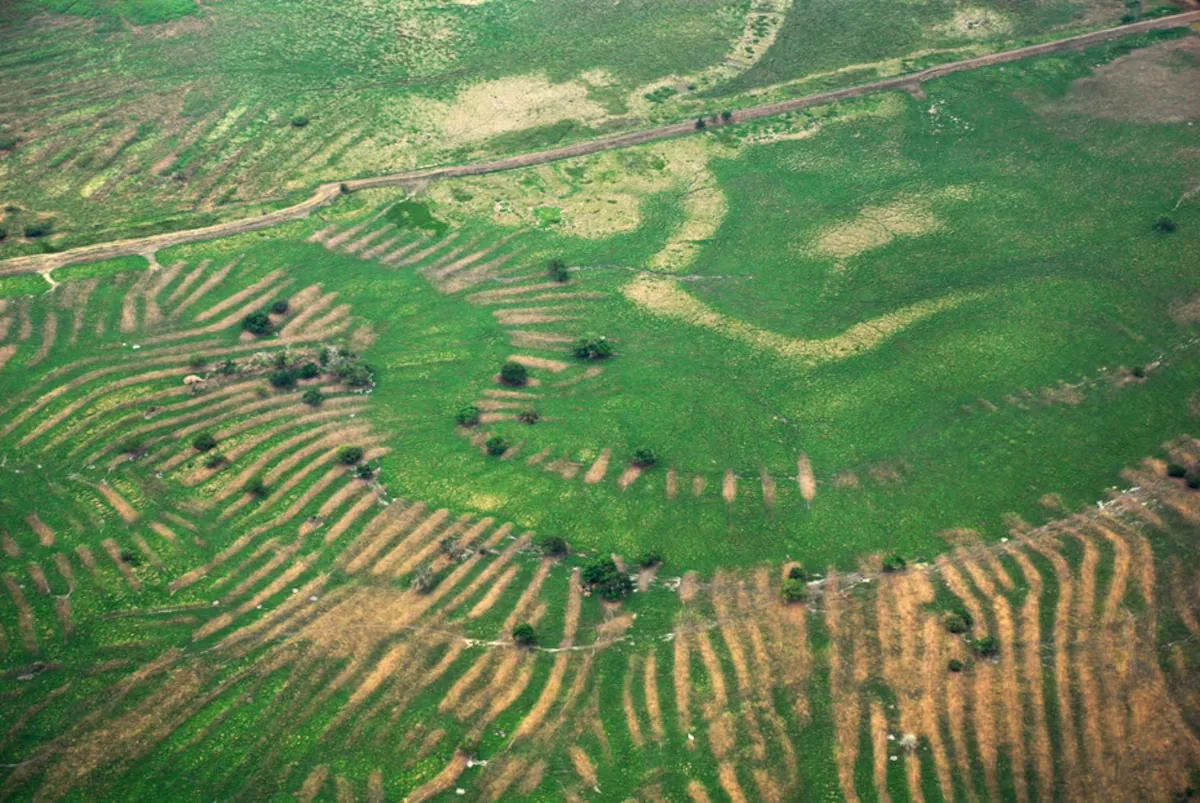
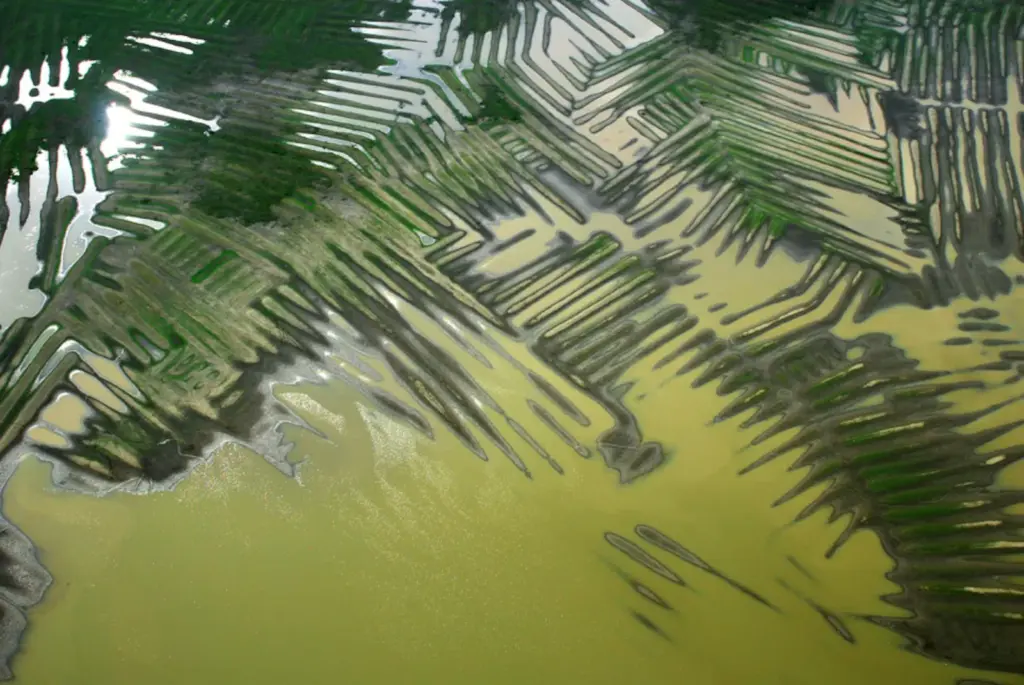
La Mojana is an inverted delta, a labyrinth of rivers that overflow and recede along eleven Colombian municipalities. An amphibious plain where the Magdalena, Cauca, and San Jorge meet to flow inland, long before reaching the sea. It is a territory that lives between two pulses, flooding and drought. But it is also the setting where, more than a thousand years ago, the Zenú indigenous people built canals and raised fields that transformed the Momposina depression into a hydraulic system capable of storing water, raising crops, and bringing fishing closer to homes. That engineering, visible today from the air as a geometric structure emerging beneath the wetlands, allowed a pre-Hispanic society to coexist with water instead of fighting it.
This is what a new study published this Tuesday in the journal Communications Sustainability suggests, indicating that these works were driven by local communities and executed in a single dry summer, without the need for centralized hierarchies. It is in that same landscape, where the State has bet on dikes that break and solutions that do not engage with the territory, that an international team of archaeologists from the University of Cambridge (UK), the Colombian Institute of Anthropology and History (ICANH), and the University of Santiago de Compostela (Spain) decided to look back. “Working with nature, rather than blocking it, can be more efficient, economical, and harmonious with the environment,” Marcos Martinón‑Torres, a researcher in the Department of Archaeology at Cambridge and co-author of the study, tells EL PAÍS.
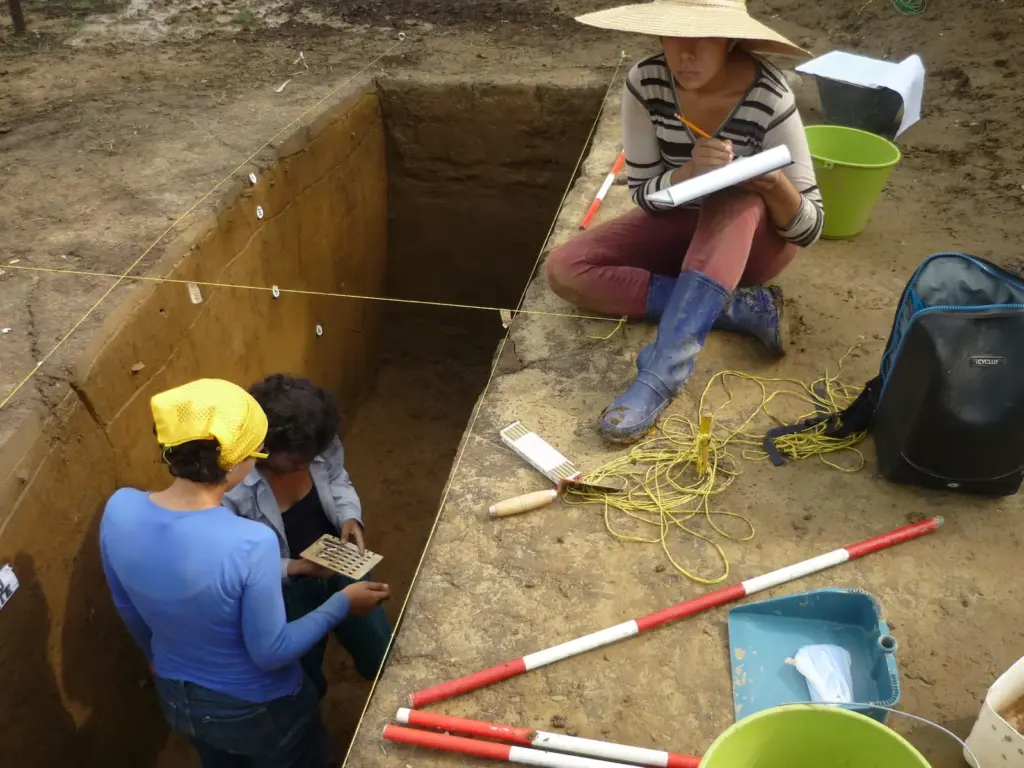
Martinón‑Torres’s statement is not rhetoric; the evidence is tangible on site. Using satellite images, the authors mapped an area of 500 hectares — equivalent to about 700 soccer fields — of these agricultural systems in the municipality of San Marcos, in the department of Sucre. They located 1,600 strips of raised land called camellones and 63 residential platforms. From this data, they made a conservative estimate of 1,600 inhabitants, with around 800 constituting the workforce needed to build those structures. The emerging image is not of a powerful state directing monumental works, but of communities that, generation after generation, shaped the water with patience and intimate knowledge of the heavy clay soils.
“It is possible to have complexity and technological sophistication without resorting to top-down coercive structures,” this expert points out. The study is part of the Reserseaction project, funded by the European Research Council and coordinated by Martinón-Torres, which seeks to understand how stateless societies could develop complex technologies. The peoples who built these hydraulic systems were contemporaries of the Maya and other societies of Mesoamerica and the Andes. But while some of those societies ended up organized around large centers of power, the Zenú seem to have found another way of doing things.
“We always tend to assume that we are the culmination of political evolution, and this shows that there are other equally viable forms of organization,” he says. Until now, based on findings such as sophisticated goldsmithing and ceramics, it had been interpreted that these were hierarchical chiefdoms in the process of becoming states. The new data does not find the evidence that would require telling that story.
Read more The privacy screen for the garden that increases intimacy without sacrificing aesthetics
There is no evidence, according to Martinón-Torres, that requires assuming centralized planning. What exists are complex works whose evidence of use disappears before the arrival of the Spanish in the 16th century. The work also leaves a tool for continued research. The researchers have made the code used in the study, developed with free software, available so that other scientific teams can apply the same methodology.
Ancient technology for a territory in crisis
The Caregato dike, an artificial wall located on the left bank of the Cauca River, suffers multiple breaks that have caused significant losses for local communities since 2021. At the same time, the region suffers intense droughts, shifting from one threat to another. “Public policy makers have shown interest in these ancient hydraulic systems, but until now lacked sufficient data,” says Dr. Fernando Montejo Gaitán of ICANH in a statement.
In Córdoba, Sucre, an association of fishermen and farmers has been reconstructing camellones following the pre-Hispanic model for more than a decade. The study mentions that it has recovered Zenú practices over an area of six hectares, raising camellones each summer with the work of about thirty people. This initiative currently benefits between 80 and 100 inhabitants.
“The State may be necessary to provide resources,” Montejo says, “but not necessarily to intervene directly.” The phrase seems simple, but in La Mojana, where water has been doing what it wants for centuries, perhaps it is not so much.
Read more The fire is still active in Niebla: “It is a fire that still has days of work ahead”