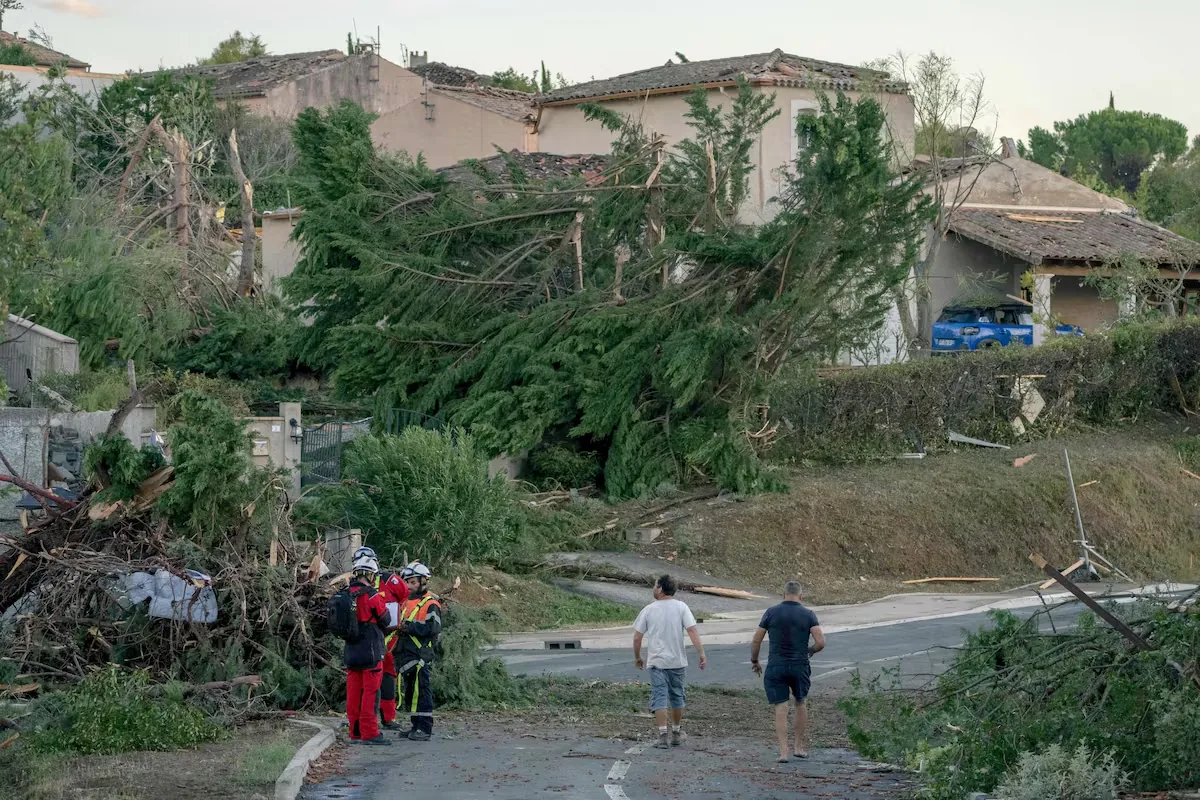
It was just after five in the afternoon when the sky began to darken in Pomas, a village of 1,000 inhabitants in the southwest of France, about a hundred kilometers from Perpignan, on the border with Spain. What seemed like a summer storm turned within minutes into a violent tornado that has devastated much of the town. It lasted a couple of minutes, enough to destroy houses and trees. There are 39 injured, 15 of them hospitalized, and 300 houses out of the fifty or so in Pomas have suffered severe damage. Videos recorded by residents from inside the homes show garden tables and chairs, containers, and pieces of roof flying through the air and fallen trees. Images typical “of a disaster movie,” as the residents have described them.
Read more A fire burns forest in Collserola, above the Canyelles neighborhood of Barcelona
Tornade dans l’Aude: les images impressionnantes des dégâts dans la commune de Pomas pic.twitter.com/LS7rinaxlT
— BFM (@BFMTV) August 25, 2026
This unusually violent tornado is the most extreme phenomenon of yesterday’s day, which was the stormiest so far this year. Much of the southwest of the country experienced some extreme weather event, with 26,000 lightning strikes and record rainfall and wind gusts in some areas. Météo France, the meteorological agency, had activated the orange alert for storms in several departments of the southwest of the country and had warned that, after the exceptionally hot summer that has occurred, such unusual phenomena could also occur.
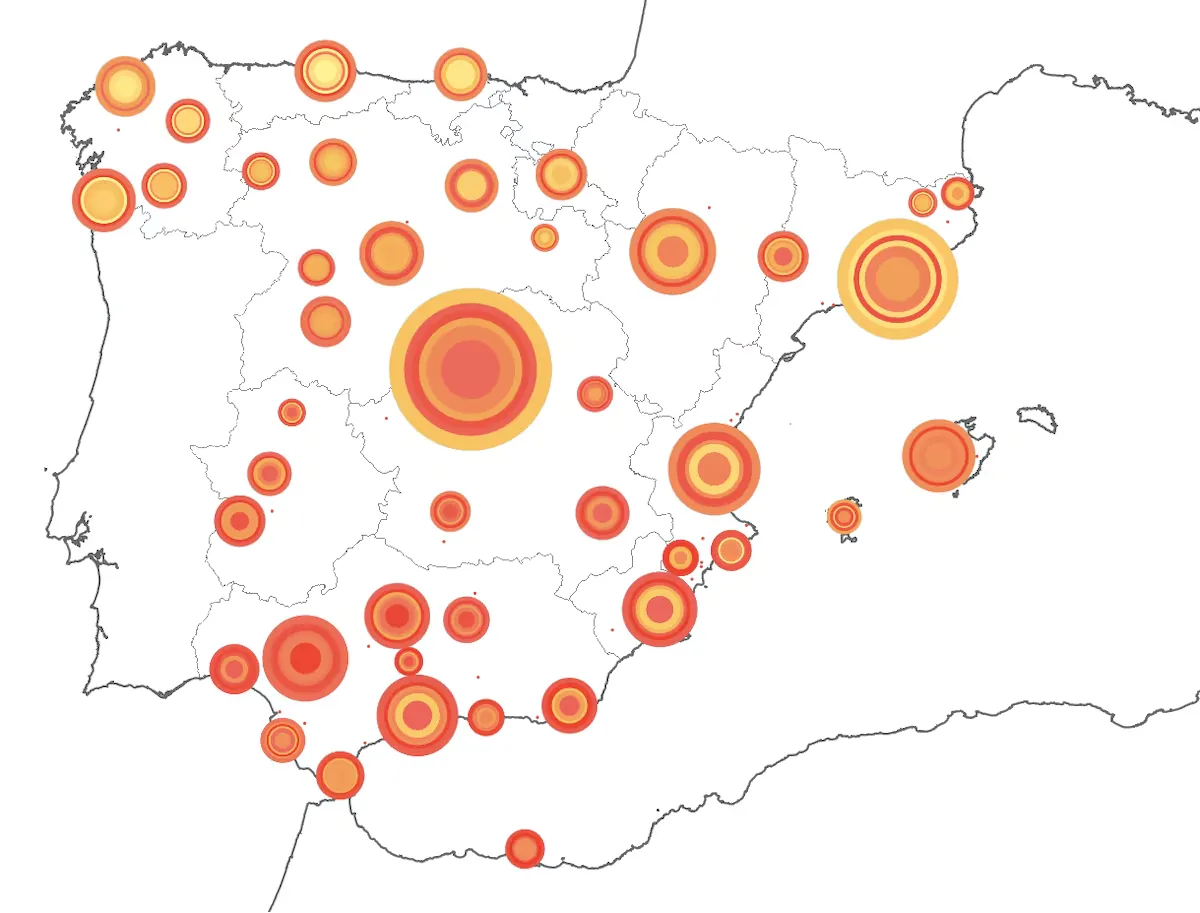
Also in Spain, the heat has given way to a sharp drop in temperatures and strong storms, accompanied by gusts of wind and hail, like those experienced these days in the Valencian Community and other areas of the southwest of the country. There is an alert for rain and storms in eight communities, and the State Meteorological Agency (Aemet) warns of phenomena that can reach considerable intensity.
Europe has experienced one of its most sweltering summers, with successive heat waves and temperature records, as well as devastating fires, but the effects of climate change, less visible, are also in the sea. A study by the scientific organization World Weather Attribution (WWA) published a few days ago warned that global warming is causing record temperatures in the Mediterranean, which increases the risk of episodes of extreme rainfall such as the 2024 Valencia DANA.
The scientists of the organization analyze to what extent global warming is behind heat waves, droughts, or floods. In this case, they have documented how it influences the temperature of coastal waters. According to the cited study, 90% of the Bay of Biscay region and 80% of the western Mediterranean have experienced marine heat waves.
According to Copernicus, the planet’s oceans recorded on Saturday the highest temperature since records began, with an average of 21.1 degrees Celsius, which has disastrous consequences for the marine ecosystem but can also cause extreme weather phenomena, such as rain or storms.
Read more Margarita García Robayo: “I would never accept a job where I had to pretend to be kind every day”
In France, dozens of tornadoes occur every year, according to Météo France, which warns that climate change may increase their intensity, frequency, and geographic distribution. “As mayor, I breathe a sigh of relief because we could have had 20 or 30 deaths. People quickly went inside their houses, which collapsed, and they have been saved (…) We could have had young people in the street. It is a miracle that there were no victims,” explained the mayor of Pomas, Hervé Giné. Météo France warns that storm activity will continue in the coming days in much of the country and new “potentially violent” phenomena may occur.
Spain escapes ‘by a miracle’
Although very striking, the French tornado is not an exceptional case, reports Victoria Torres. “We have previously had tornadoes of this virulence in Europe [preliminary estimates point to an EF2-EF3 strength, which would be equivalent to a category 3 or even 4 hurricane]. They are infrequent but not unprecedented. France has documented more than a thousand and there are historical episodes,” explains Mar Gómez, PhD in Physics and head of meteorology at eltiempo.es, adding that estimates place the number of land tornadoes in Europe at around 300 per year, “although there is quite a bit of underdetection.”
The big question is whether their virulence and frequency have surged in the old continent due to climate change. “To date, there is not enough robust evidence to state that the number of tornadoes is increasing in Europe, and the IPCC itself [Intergovernmental Panel on Climate Change] points out that the available series still do not allow establishing a clear trend. What we do know is that a warmer atmosphere can hold more water vapor and that warmer seas provide more moisture and energy to storms. That can favor environments with greater instability and increase the capacity of some storms to produce extreme precipitation, hail, or severe convective phenomena,” Gómez responds.
In this context, Spain escaped by a miracle. “A tornado of these characteristics could also have occurred in Spain, because yesterday [Monday] in some areas of the northeastern peninsula, favorable ingredients for developing severe storms were present: lots of heat and moisture in the lower layers, colder air aloft, high instability, and wind shear [a sudden and strong change in wind speed or direction over a short distance, either vertically or horizontally],” the expert indicates. In fact, extreme phenomena also occurred in Tarragona, such as “very organized and violent storms” and wet downbursts. “But having the ingredients does not necessarily mean a tornado will form. Tornadogenesis depends on very local processes, how each storm evolves, and whether a sufficiently intense rotation organizes. But the risk was present,” she clarifies.
Moreover, the French tornado, the storms in Tarragona, and the rissagas that occurred the same day in the Balearic Islands are part of the same phenomenon, “of the same episode of strong atmospheric instability in the western Mediterranean and southern France, but they are different manifestations.” In Tarragona, there was “very intense convection, with torrential rains, hail, and strong gusts associated with the storms.” The French tornado “was a much more localized phenomenon generated by the rotation of a supercell.” And the rissagas are “meteotsunamis, rapid oscillations of sea level caused by atmospheric pressure changes and disturbances associated with storms.” In her view, “we can imagine it as the same very energetic atmospheric scenario that ends up expressing itself in different ways depending on the place.”
Read more The ghost of the civil war looms over Yemen amid the Gulf crisis