








Florida authorities announced on Tuesday that they have launched a criminal investigation into artificial intelligence company OpenAI, in connection with a shooting that left two dead at a university last year.
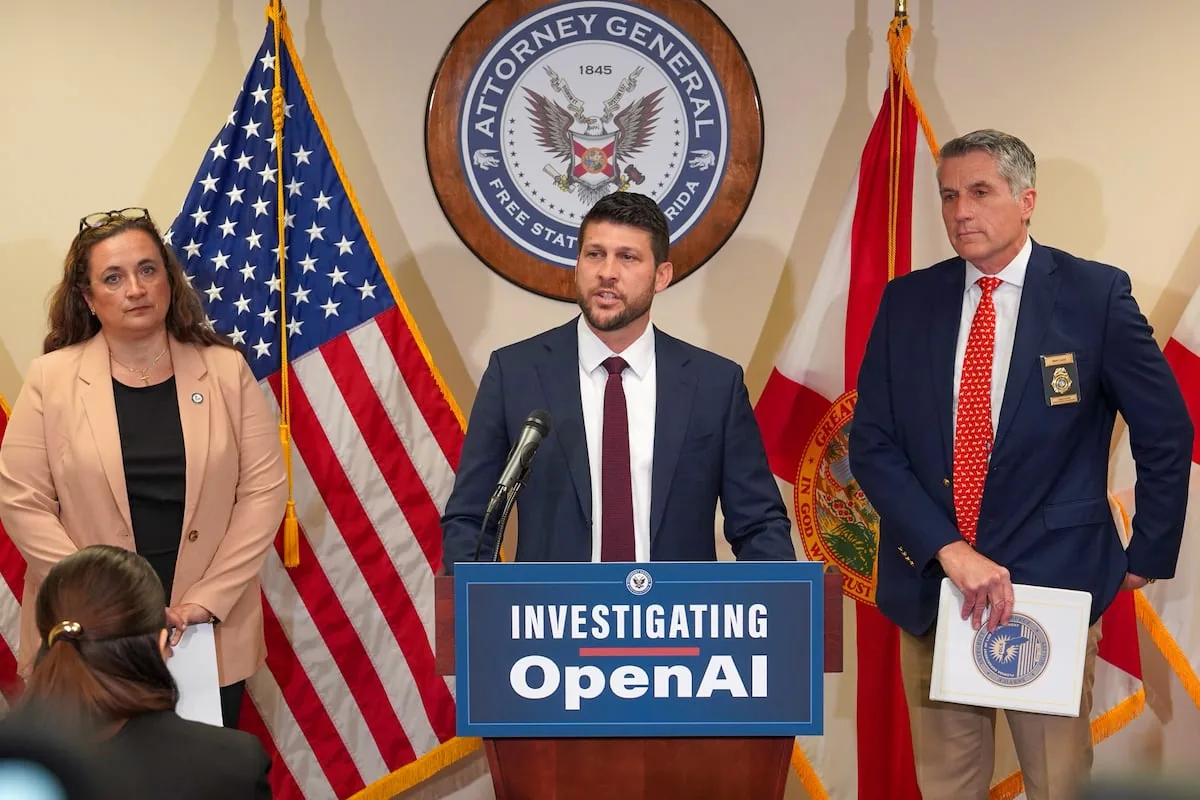
Florida Attorney General James Uthmeier made the announcement at a press conference in Tampa. The prosecutor explained that conversations between the suspect and ChatGPT, the company’s chatbot, indicate that the system suggested to the shooter what type of weapon or ammunition to use, whether the attack should be carried out at close range, at what time of day the location would be most crowded, and in which areas of the campus a greater concentration of people could be found.
“ChatGPT offered significant advice to the attacker before he committed these heinous crimes,” Uthmeier said. “If it had been a person on the other side of the screen, we would charge them with murder. Of course, ChatGPT is not a person, but that does not exempt our office or my team of prosecutors from the obligation to investigate whether there is criminal liability on the part of a corporation,” he added.
In April of last year, a student at Florida State University (FSU), in Tallahassee, in the north of the peninsula, opened fire near the student union, killing two people and injuring six, including several students. The suspect, Phenix Ikner, then 20 years old, faces several murder charges.
A spokesperson for OpenAI told EL PAÍS that the FSU shooting “was a tragedy, but ChatGPT is not responsible for this terrible crime.” “Upon learning of the incident, we identified a ChatGPT account believed to be associated with the suspect and proactively shared this information with authorities. We continue to cooperate with them. In this case, ChatGPT provided factual answers to questions with information that can be widely found in public sources on the internet, and did not encourage or promote any illegal or harmful activity. ChatGPT is a general-purpose tool used by hundreds of millions of people every day for legitimate purposes. We continuously work to strengthen our safeguards to detect harmful intent, limit misuse, and respond appropriately when safety risks arise.”
Uthmeier said that the State has already filed charges in crimes related to child pornography images generated with AI. The prosecutor recalled that the state legislature last month approved a new law that significantly increases penalties for sexual offenses against minors, including the creation of AI-generated child sexual abuse material.
The announcement comes in a broader context of regulatory momentum in Florida regarding artificial intelligence, amid growing tension between the federal government and individual states over who should regulate this technology.
Florida Governor Ron DeSantis included a bill called the “Artificial Intelligence Bill of Rights” in a special session scheduled for the end of the month. This would function as a kind of safeguard against the risks of these technologies and would include data protection and legal mechanisms against abuses.
The Charter was approved by the Florida Senate — with 35 votes in favor and two against — as bill SB 482, but did not advance in the House of Representatives. The bill incorporates certain safeguards for individuals considered vulnerable because they could be confused by the technology, such as minors, older adults, and people with cognitive difficulties, who may be more susceptible to manipulation.
“The bill addresses current transparency challenges for consumers, threats to child safety, and other potential impacts stemming from technological advancements in artificial intelligence,” wrote Senate President Ben Albritton in a memo announcing the special session.
In the absence of comprehensive federal legislation, states have moved forward with a growing patchwork of artificial intelligence regulations, with more than 1,500 initiatives so far in 2026. California, Texas, and Colorado have adopted laws focused on transparency, ethics, and “high-risk” systems — such as those used in employment or housing. Utah, Illinois, Washington, Oregon, and Idaho, among others, have implemented measures regulating everything from job interviews to educational standards, among other activities.
However, the Donald Trump Administration has warned that a patchwork of state laws could stifle innovation. Last month, the White House presented a plan called the National Artificial Intelligence Legislative Framework, which sought to create a roadmap for federal AI legislation.