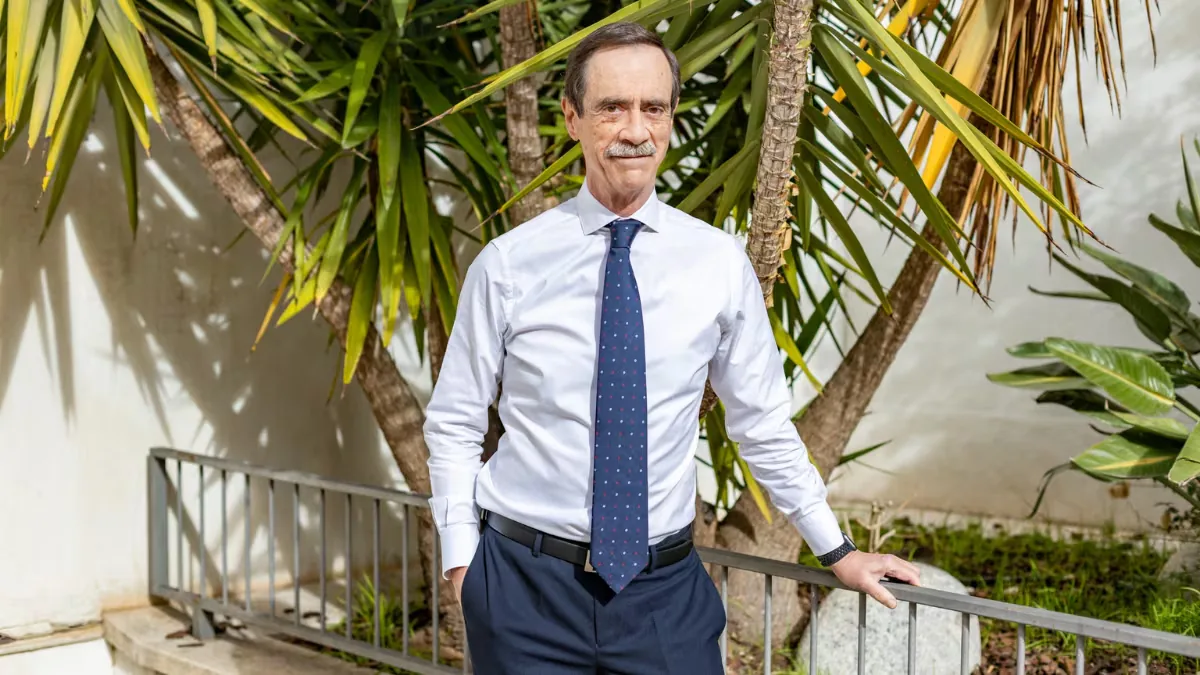
What if the real problem of our time was not misinformation, but the loss of judgment? What if society had started to reward appearance more than knowledge, noise more than reflection, and mediocrity more than excellence? This is the thesis defended by Santiago Ávila in Tontocracy. In Search of Lost Common Sense (Vergara, 2026), an essay in which he analyzes how this logic has been installed in politics, business, education, and the media.
Read more Fires: prevention is key
Doctor in Economics, career military, university professor, and former executive of large companies, Ávila argues that the problem does not lie solely with those in positions of power. In his view, the responsibility also falls on a society that has stopped valuing knowledge, effort, and critical thinking to embrace the comfort of easy answers. In this interview, he reflects on the role of education, leadership, social networks, and artificial intelligence, but also on the need to train citizens capable of thinking for themselves.
Question. The book starts with a strong statement: we live in a society that rewards banality, punishes excellence, and has normalized mediocrity. It is a deliberately provocative thesis. To start at the beginning, what exactly is tontocracy and why do you believe we live in one?
Answer. Well, I didn’t invent the concept of tontocracy. I refer to the environment we are living in, but many authors had already talked about it. Stephen Covey, for example, said that until World War II the ethic of being predominated, and afterwards, the ethic of appearing was imposed. Before, a handshake was worth more than a contract; now appearance matters much more than what one really is. We live in constant appearance.
And, moreover, we live in an overacted way. In the workplace, they talk about workplace happiness; in education, that students have to be happy… But what are you telling me? Very important concepts are being trivialized. What I try with the book is to fight against that and recover a bit of common sense that, in my opinion, we have lost.
Today anyone, hiding behind technology, can say the biggest nonsense and, as long as they say it confidently, it has enormous impact. Just look at politics: we live in the appearance of appearance. Telling the truth, being honest, seems no longer fashionable. Now the important thing is to be clever. If someone has a lot of money, even if they got it unethically, some say: “Look how smart he is.” And I think we have to fight against that because it is a moral misery.
Q. Some will read the book and think there have always been mediocres, opportunists, or charlatans. What makes this moment different?
A. Because now mediocrity is standardized. Before, a mediocre person was someone you tried to stay away from. Now, often, they are the ones who succeed. We see it in politics: instead of trying to elevate society, many leaders just look at where the current is going and join it to get votes. They don’t try to lead it to a better place, but to simulate that they do. And that ends up being a big lie.
But it is not an exclusive problem of politics. It also happens in business, education, or society itself. Anywhere there is power, there are power struggles, and often the mediocre ends up being promoted because they are less uncomfortable than someone brilliant. I saw it very early. I remember my first works council: every time I made a comment to improve something, there was an uproar. During a break, I asked what was happening and they told me: “Every time you say something sensible, those who don’t want the company to change use your words to block it.” That’s when I understood that not everyone was working for the good of the organization; many were only thinking about how to benefit themselves.
There is an anecdote in the book that sums up this logic very well. When I was 14 years old, the school organized a nativity scene contest. My group had no intention of making an effort and we ended up making a pretty bad nativity scene. We were convinced we would come last, but we ended up in the middle of the ranking. Why? Because those who had made the best nativity scenes voted for the mediocre one so as not to give votes to a strong rival. Over time I have seen the same attitude in politics and companies: sometimes the best is not chosen, but the one who represents the least threat.
Q. In the book you dedicate an entire chapter to education. Why do you think it is one of the places where this drift is best observed?
A. Because it is where it is seen first. Everything starts in the family, but where it acquires a much clearer presence is in education. Today teaching is practically impossible. I’m not even talking about the veneration that a good teacher could have before, but something much more basic: respect for their authority has been lost. Many families do not accept a failing grade because it complicates their lives, and that ends up transferring to the classrooms.
At university, I have had students coming in and out of class constantly or combing a classmate’s hair in the middle of the explanation. And when you try to set limits, you become authoritarian. In the end, many teachers give in because facing that situation only brings them problems.
But the one harmed is not only the teacher; the student is also harmed. If you get a person used to never having an academic disagreement, when real life comes, they don’t know how to face failure, a work problem, illness, or disappointment. We have transmitted the idea that one comes into the world to be happy, and to me that seems a terrible fallacy. Precisely for that reason, my next book will go against that forced happiness.
Q. We live surrounded by information and yet you argue that there is less and less critical thinking. What is failing?
Read more The Living Thought of Averroes
A. The problem is not information, but what we do with it. Today we have an enormous amount of information, but that does not mean we have more knowledge. It is the first time we see so many higher education graduates who are functional illiterates. There are university students who finish a degree and do not know how to interpret a text or solve a rule of three. And that is very serious.
Now it seems that knowledge works like a supermarket: I need something, I go to artificial intelligence, I take it, and move on. But if you don’t have a prior base, you can’t know if that answer is correct either. It has happened to me that some student handed me an article I had written as their own. If you don’t have knowledge, you can’t discern. First is information; then knowledge, which consists of structuring it; and only then can you apply intelligence to that knowledge.
AI is very useful for operational knowledge, to solve tasks, but it has no affective or speculative knowledge. It does not anticipate the human consequences of a decision nor does it have ethics. And that is why I am concerned that many young people are even entrusting it with psychological matters. In anthropological terms, artificial intelligence is a psychopath: it knows how to operate, but it doesn’t care what happens from an emotional or ethical point of view.
Q. Are social networks and artificial intelligence the cause of the problem or do they simply amplify something that already existed?
A. They are a tool. If the being is well built, they can be extraordinary; if it is poorly built, all they do is amplify the problem. Before, nonsense stayed at the bar counter or in a conversation among friends, but now anyone can take a mobile phone, say the biggest nonsense, and find thousands of people willing to share it. Technology does not change human nature; it simply gives it more reach. That is why I do not believe social networks are the cause of this drift, but the loudspeaker of a problem that already existed.
Q. Besides being a university professor, you have spent more than two decades leading teams and holding positions of responsibility in large companies. From that experience, how does tontocracy manifest itself within organizations?
A. It manifests when leadership stops looking for the best and starts surrounding itself with people who question nothing. There are executives who prefer to have flatterers around rather than brilliant people, because a competent person is always more uncomfortable. That ends up impoverishing the entire organization.
A good leader does not need to always be right; they need people who bring different points of view. If everyone thinks the same, the company stops learning. I have seen it many times: those who cause fewer problems are promoted, not necessarily those who add the most value. And so a culture is built where servility weighs more than talent.
Q. In the book you question a very established idea in recent years: that the goal of education, work, or even life should be happiness. What worries you about that discourse?
A. I worry that it becomes an empty slogan. I don’t go to work to be happy; I go to work to do my job well. If I also find a good environment, great, but turning happiness into an obligation generates frustration, because no one can be happy permanently.
I think we have confused well-being with happiness. There are very hard jobs that are worth it and difficult moments that are also part of a full life. If we transmit that any discomfort is a failure, we are educating people incapable of facing reality. Happiness cannot be the goal of an organization; it should be, in any case, a consequence.
Q. After everything we have talked about, one might conclude that the responsibility lies with those in positions of power. However, you argue that it also falls on the rest of society. To what extent are we co-responsible for the tontocracy you denounce?
A. We are much more co-responsible than we like to admit. We tend to think the problem is always with those in positions of power, but a society also decides which behaviors it rewards and which it tolerates. If we stop valuing knowledge, effort, or honesty, we cannot be surprised when those who reach the top represent precisely those values we have normalized.
That is why I believe the solution lies in training adult citizens, with judgment and capable of thinking for themselves. Education has a lot to do with that. A society improves when its citizens are demanding of themselves and also of those who aspire to lead it.