Over the past two years, the conversation about artificial intelligence has almost always revolved around the same question: who uses it and how. We have talked about ChatGPT in classrooms, students doing homework with the help of a chatbot, teachers trying to adapt to a technology that evolves at a dizzying pace, and companies seeking to learn how to make the most of it. AI has ceased to be a promise and has become an everyday tool.
Read more At least 12 dead and dozens injured in a Russian missile attack on Kyiv
However, the debate about artificial intelligence no longer revolves solely around its use, but about who will learn to build it. Because those who develop the models of the future will also decide with what data they are trained, what problems they try to solve, and what limits they must respect.
“It is not enough for students to know how to use artificial intelligence; they have to understand how it works, question it, and be able to create with it.” This is how Fran García del Pozo, head of CodeAI in Spain, summarizes the change education is undergoing. That way of relating to technology — more critical, more creative, and less limited to simple use — is what CodeAI calls digital fluency. It is no longer just about teaching how to handle a tool, but about preparing those who will one day make decisions about it.
This change of perspective is precisely what , a report prepared by Deloitte, CodeAI, and the Princess of Girona Foundation, tries to explain. The work starts from a fact: while the gap between men and women in the use of artificial intelligence tools is beginning to narrow, women remain a minority in the studies that lead to developing this technology, in the teams that create it, and in the positions from which decisions are made about its future direction.
“It is no longer enough to ask who uses artificial intelligence; we must ask who designs it, who decides with what data it is trained, and who governs it.” For Ana Torrens, president of Deloitte, that is the real change in the conversation. Because if artificial intelligence is destined to increasingly influence education, healthcare, employment, or relations with public administrations, the issue ceases to be exclusively technological. It also concerns who participates — and who is left out — of the decisions that will end up affecting the whole of society.
AI does not start in Silicon Valley
It would be easy to think that the gender gap in artificial intelligence begins when it comes time to choose a university degree. Or when a company decides whom to incorporate into a development team. However, the journey begins much earlier. It starts in childhood, when girls and boys discover what interests them, what they believe they are good at, and above all, what futures they feel can also be theirs.
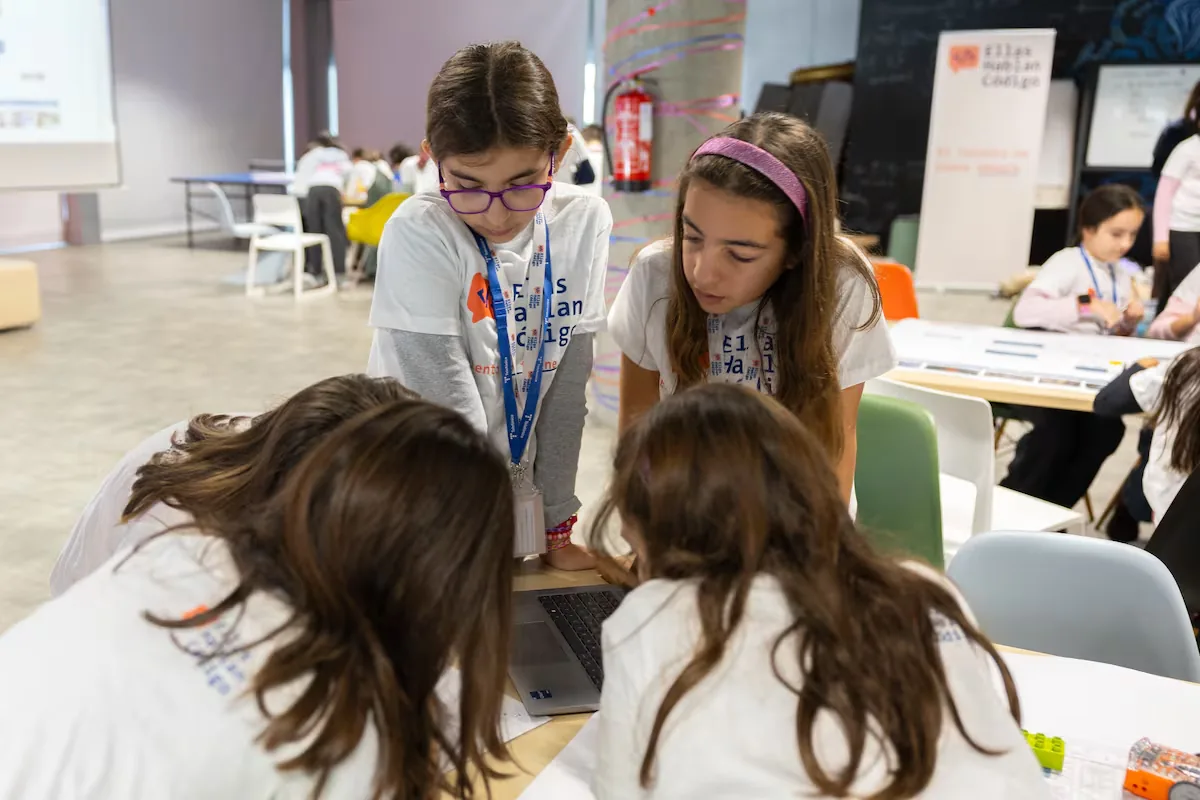
“Opportunities must be opened and sparks ignited.” Sandra Camós, head of educational programs at the Princess of Girona Foundation, sums up the philosophy with which they work. “We can always broaden the perspective, foster curiosity, and teach girls and boys that talent has no limits,” she says. The issue is not to convince anyone to study a technological degree, but to ensure that any student can come to imagine that future as a real possibility.
This process rarely corresponds to a specific moment. It is built little by little: in the role models they find inside and outside the classroom, in the expectations they perceive from their families and teachers, or in the experiences that make them discover that technology can also be a space for them. That is why research places the origin of the gap long before university: interest in computational thinking shows hardly any differences during Early Childhood Education, but the distance begins to open in Primary and becomes more pronounced during Secondary Education.
For Camós, much of this process depends on the teaching staff. “Those who have to be the lever are the teachers. If they are not trained, if they are not prepared and are afraid not only to use artificial intelligence but also to know it, understand it, and be competent, it is very difficult,” she warns. More than incorporating a new tool into the classroom, she maintains, the challenge is for teachers to be able to accompany students in a technological environment that evolves rapidly.
University, Torrens argues, is not where that gap is born; it is where it becomes visible. The lower female presence in artificial intelligence development “does not start in the labor market or at university.” It starts much earlier, “in the way girls and boys relate to technology, in the messages they receive, in the role models they see, and in the expectations projected onto them.”
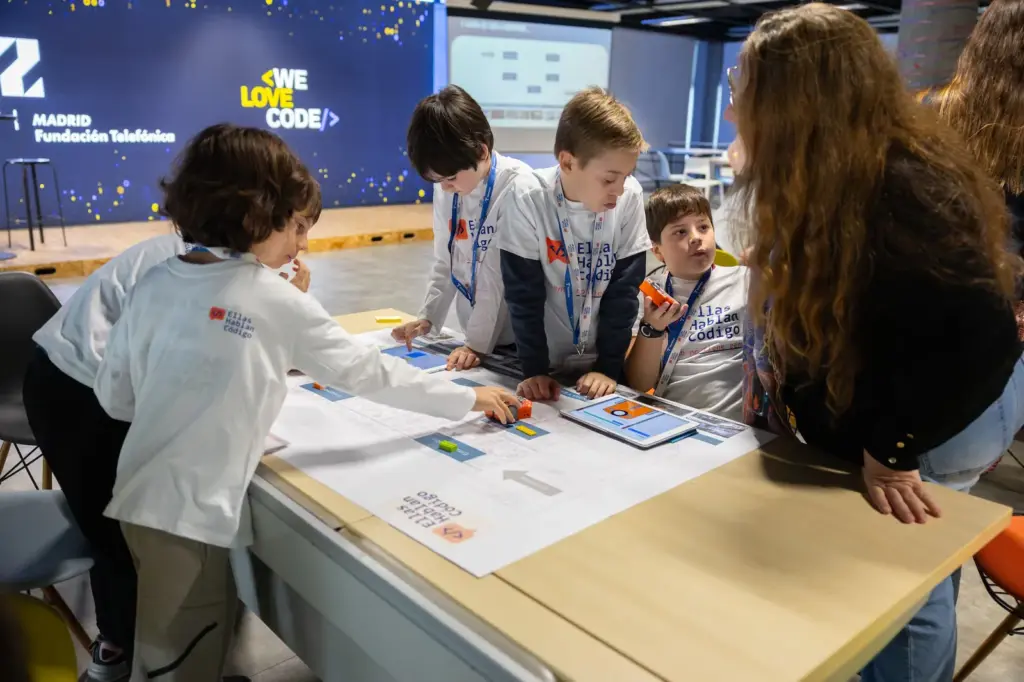
The change starts with the teacher
“Education is the greatest treasure any country has,” Camós recalls, convinced that any conversation about artificial intelligence eventually leads to that idea. If the goal is for more girls and young people to one day develop this technology, the first step is not to wait for them to choose a university degree, but to prepare those who will accompany them throughout that journey: the teachers. “If we want good education, we have to invest in them,” she maintains.
Read more China sentences founder of real estate giant Evergrande to life imprisonment
That conviction led the Princess of Girona Foundation to start where, at first glance, it seemed less obvious: the Education faculties. Camós recalls that many Education students received the proposal to learn programming or artificial intelligence with some disbelief. “They looked at us as if to say: ‘Is this woman crazy? I, who am going to be a preschool or primary school teacher, have to learn to program?’” However, that perception changed as that initial 28-hour training progressed. They discovered it was not about learning a computer language, but about incorporating new tools to teach, awaken curiosity, and help students solve real problems.
For years, the great goal was to bring programming closer to millions of students. Today, García del Pozo maintains, that challenge has fallen short. Artificial intelligence has changed the educational scenario so quickly that learning a programming language is no longer enough. “AI programs, yes, but this is no longer about that. It’s about everything you can do with it,” he summarizes. That is why he talks about “augmented humanity”: a technology that expands people’s capabilities rather than replacing them, and that forces preparing students for professions that, in many cases, do not even exist yet. That paradigm shift also explains Code.org’s evolution towards CodeAI, a name that tries to reflect a much broader mission than teaching programming.
But that transformation will hardly reach classrooms if teachers themselves feel they are moving blindly. The latest edition of TALIS, the OECD’s international study on teachers, precisely places one of the main challenges there: a large majority of teachers acknowledge they need more training to integrate artificial intelligence into their educational practice. That reality reinforces an idea emphasized by both Camós and García del Pozo: before preparing students to live with AI, those responsible for teaching it must be prepared.
That same idea explains why the Foundation and CodeAI decided to take much of their work to rural schools. Not because there was less technology there, but because those centers have been doing something for years that the entire educational system now demands: continuously adapting teaching to students with different needs (and ages), working on projects, connecting learning with the environment, and making the community part of the classroom. “Innovation there is not a luxury; often it is a necessity,” Camós maintains. In that context, AI ceases to present itself as an end in itself and becomes just another tool serving a way of teaching that already placed students at the center long before ChatGPT existed.
“In the end,” García del Pozo concludes, “we are no longer just training those who will develop artificial intelligence.” We are training the generation that will live with it, question it, decide when to use it and when not to. And that ceases to be an exclusive challenge for engineers or technology specialists to become a responsibility shared by all education.
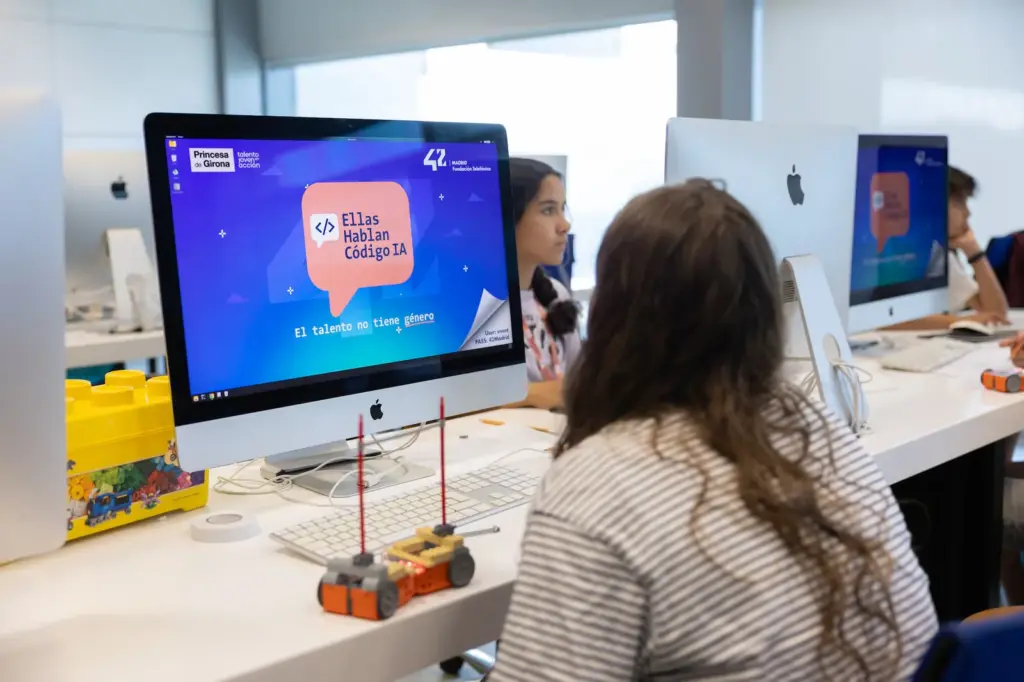
Diversity also improves AI
Artificial intelligence will learn more and more about us. It will help diagnose diseases, recommend educational content, participate in personnel selection processes, or facilitate relations with public administrations. But before doing all that, someone will have decided with what data it is trained, what problems it tries to solve, and what questions are worth asking. That is where Torrens places an essential part of the debate. “From a business perspective, it reminds us that we are in a context of talent scarcity and that we must make the most of it.” Leaving out part of that talent, she maintains, is not only a matter of equality; it also limits the ability to build better artificial intelligence.
“Diversity changes the questions from the start,” Torrens summarizes. And when the questions change, the answers also change. That is why she maintains that incorporating more women into artificial intelligence development is not only a matter of equity. It is also a way to enrich innovation and build technologies capable of responding to a much more diverse society.
An example helps to understand this. An artificial intelligence tool for education can be technically flawless and yet be of little use in a classroom if only technological profiles participate in its design. “We also need teachers, pedagogues, child protection specialists, families…” The more experiences and knowledge converge in that process, the greater the chances of developing tools capable of responding to real situations and not just theoretical problems.
Known cases of algorithms that reproduced gender biases or facial recognition systems that offered worse results for certain groups demonstrated that the problem was not only in the technology. It was also in the data used to train it and in the human decisions that accompanied the entire process. That is why, for Torrens, the governance of artificial intelligence “is not only a technical or regulatory issue; it is also a matter of trust.” Trust that, she concludes, can only be built when society “recognizes itself in those who make the decisions.”
Read more Arrested after stabbing his uncle to death in the Valencian town of Massanassa