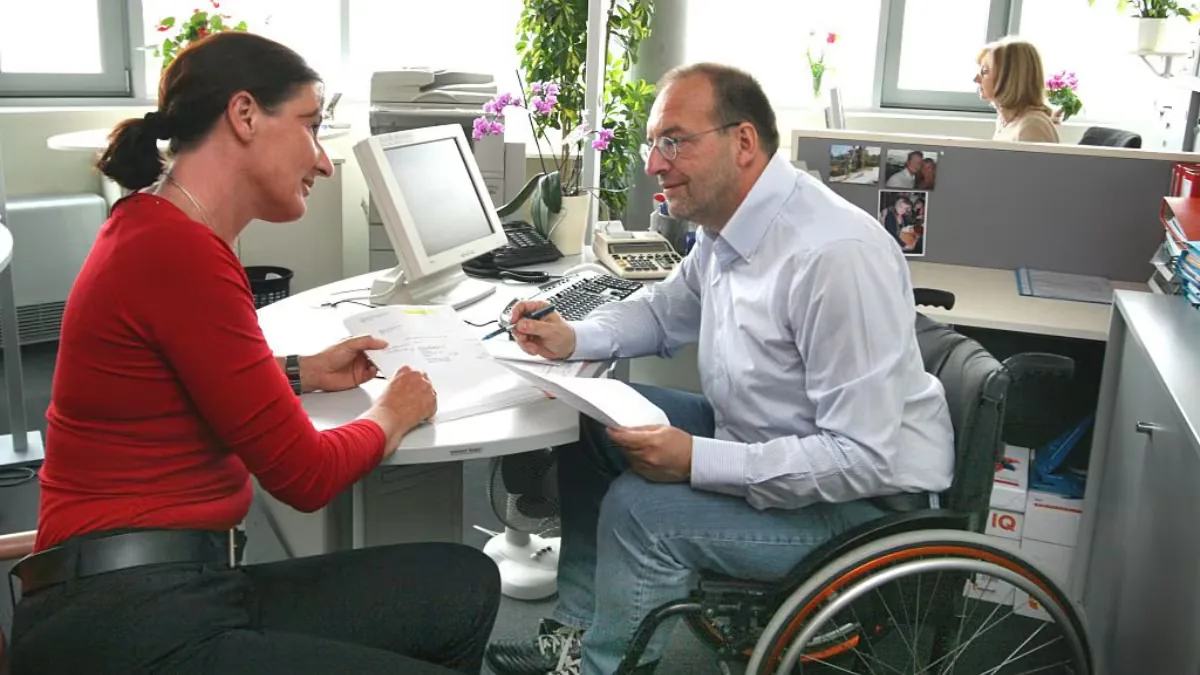
For years, access to education was the first step towards labor inclusion for people with disabilities. A step that, although far from being resolved, has advanced like never before: 82% of people with disabilities of working age now have secondary or higher education, and higher education has grown by 53% in the last decade, according to the report Are people with disabilities prepared for the labor market of the future?, prepared by the Randstad Foundation.
Read more Man arrested after fleeing following the murder of his ex-partner in a shopping center in Murcia
The data also reflect another significant advance. In the last 10 years, employment for people with disabilities has grown by 42%, adding 166,000 more employed. But this progress also coexists with a less visible paradox, as educational improvement is not translating into a similar growth in jobs that match that preparation.
“For a long time, the focus was on improving access to training, and that has been largely achieved,” explains Marta Valer, director of Strategic Alliances and national coordinator of the Randstad Foundation. “But now the challenge is different: to transform that talent into real employment and professional development opportunities. The capabilities are there; what does not always exist is the opportunity.”
This change of scenario is not exclusive to Spain. The Organization for Economic Cooperation and Development (OECD) already warned in 2022, in the report Disability, work and inclusion: integration in all policies and practices, that improving the educational level of people with disabilities was a necessary but insufficient condition to reduce the labor gap. The next challenge, the organization maintained, was (and is) to also adapt companies, hiring processes, and employment policies to a labor market in full transformation.
A paradox with numbers
The numbers help to better understand this contradiction. Although 32% of employed people with disabilities have higher education, only 23% hold highly qualified positions. And, at the same time, barely 7% have basic education, but elementary occupations concentrate 22% of employment. In other words: a significant part of the talent trained in the last decade continues to perform jobs far below their preparation.
For Valer, the explanation lies in the barriers that appear even before hiring: “The main problem is unconscious biases and the barriers that exist when giving opportunities to people with disabilities.” In her view, many companies still associate disability with certain professional profiles and find it hard to imagine these candidates performing higher responsibility positions.
The gap is also observed, for example, in IBEX 35 companies. “Only 9% of IBEX 35 companies directly incorporate people with disabilities in compliance with the General Disability Law. Most resort to alternative measures allowed by the regulation [such as donations to organizations working for inclusivity],” says Valer. “This means that many highly qualified people do not have the possibility to access certain positions. We still find a lot of fear, bias, and ignorance. Companies are not prepared to conduct inclusive selection processes,” she adds.
This perception echoes other recent studies. The latest report Youth with disabilities, engine of the future, from the Adecco Foundation, indicates that 55% of young people with disabilities say they have experienced some form of discrimination during their job search and that 38.5% consider that, in interviews, the focus is placed more on their disability than on their skills.
A labor market that does not wait
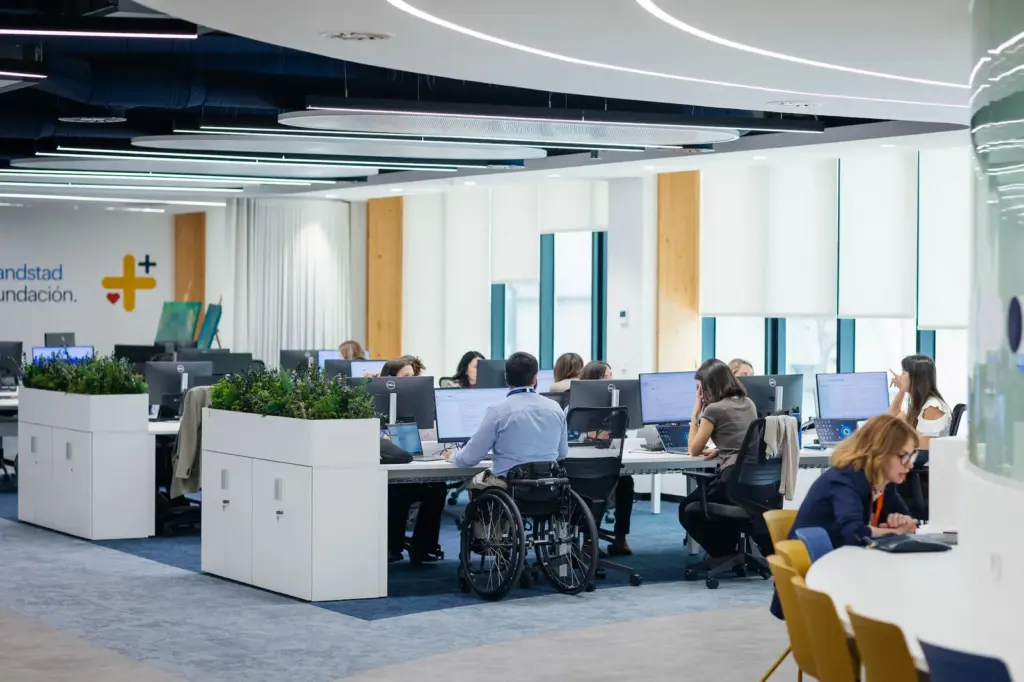
So far, the problem could be understood as a mismatch between the preparation of many people with disabilities and the type of employment they manage to access. But the Randstad report adds another element that changes the perspective: the labor market is evolving at a speed that waits for no one.
Nearly 39% of the skills that companies demand today will change before 2030, warns the study. Skills such as analytical thinking, digital literacy, adaptability to change, or the use of new technologies will gain much more weight, while others associated with more repetitive tasks will lose relevance.
The problem is that a large part of people with disabilities continue to develop their professional careers precisely in jobs where this transformation advances more slowly. 67% of the employment of the group is concentrated in occupations associated with stabilized or declining skills, a reality that, according to the report, may hinder their access to professions with greater projection in the coming years.
The risk is not limited to occupying positions with less career potential. Many emerging skills are developed and consolidated precisely through work experience. Therefore, when that experience takes place in occupations with few possibilities for evolution, the opportunities to acquire them are also reduced.
There is a contrast that is hard to overlook. Technical and professional occupations performed by people with disabilities have grown by more than 70% in the last decade, proof that access to higher qualified jobs is possible. But, at the same time, elementary occupations have also increased by 56.5%, precisely those most exposed to automation and technological transformation.
Valer rejects a fatalistic view of the future. In her opinion, the issue is not whether certain jobs will disappear, but whether people will have access to continuous training that allows them to accompany that transformation. “We must continue to bet on reskilling and upskilling, on retraining and updating skills so that people with disabilities can access jobs with more career potential and less exposed to the changes the labor market is already experiencing,” she argues.
That concern is also already present among young people themselves. According to the Adecco Foundation survey, 42% fear that artificial intelligence will reduce their opportunities to access their first job, a perception that connects with the rapid transformation of the labor market described by the Randstad Foundation.
From access to professional development
Getting a person with a disability to access a job can no longer be the final point of labor inclusion. That moment actually marks the beginning of another challenge: that they can continue training, take on new responsibilities, and develop a professional career in line with their preparation.
Valer believes that this transformation also requires reviewing how companies understand inclusion. “We cannot be satisfied with incorporating a person with a disability into a job and consider the process finished,” she says. In her view, inclusion will stop being measured solely by access to employment and will begin to be measured by organizations’ ability to identify, leverage, and retain that talent.
This change also shifts the center of the debate. For years we asked what people with disabilities needed to be prepared for the labor market. Today the question begins to be different: whether companies are prepared to recognize those capabilities and foster them in a market that changes faster and faster.