








In the front row of a university classroom in Cuenca, an elderly woman begins to speak about the post-war period, when she was a child living in the Ávila town of Santa Cruz del Valle. She ate picoyas and aceberas pulled with her own hands from the ravines of Puerto del Pico; plants that only locals knew and that were necessary to overcome the scarcity of those years: “In the countryside, the post-war was experienced differently from how it was lived in the cities. That’s what people don’t know,” she recalls. The young people listening to her, who today have the opportunity to speak with her, are students in an Anthropology class at the University of Castilla-La Mancha. They look at her intently, aware that they are before an unmissable and living testimony of the recent history of this country.
Read more Jaafar Jackson’s process to portray his uncle, Michael Jackson, in the ‘King of Pop’ biopic
Her name is Mari Ángeles Martín. She is 83 years old, and she is one of approximately 60,000 students enrolled throughout Spain in university programs for people over 50. She belongs to the José Saramago study plan, which serves more than 1,200 students on the La Mancha campuses, and she has asked her professor for permission to attend traditional university classes, those for future graduates and mostly composed of students around 20 years old.
She looks at the young people with curiosity. She has traveled half the world since she left Santa Cruz del Valle in 1964. As she couldn’t study, she emigrated to Switzerland. And some time later, together with her husband, she was able to collect around 3,000 books, both of them admirers of geniuses who, like her, could not receive adequate education for economic reasons, such as the poet Miguel Hernández himself. Then they traveled through other European and Latin American countries, such as Argentina or Brazil, eager to learn about other cultures.
“In those years, it was very difficult for a girl to study,” she explains. “Some from the village studied to be teachers or nurses, those who could afford it. And my father was a teacher, but teachers earned very little.” That’s why she decided to emigrate. She longed to socialize, to see the world. And although the dictates of everyday life led her to domestic tasks, being the eldest of her eight siblings, she decided to break with everything. And now her lively gaze once again attracts the youthful desires for knowledge.
Seniors who resist being alone
In Spain, it is estimated that two million people over 65 live alone. This tendency towards a lack of relationships increases with age, reaching a critical point from the age of 80. Therefore, for them, the idea of accessing training programs fulfills not only an intellectual function but also a human and social one. Mari Ángeles found this possibility when she returned to Spain and settled in Cuenca. She resisted living her days isolated, like other seniors, and although she had the company of books, it seemed insufficient.
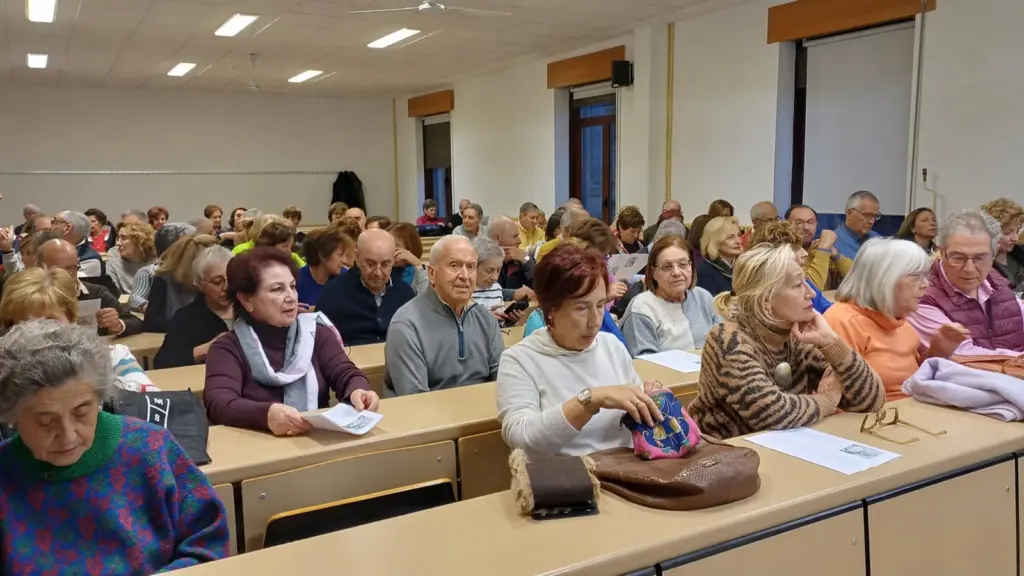
However, the fear she experienced quickly vanished when she found in her classmates the same eagerness and motivations to learn. There she attended various events and workshops and took subjects divided into three major academic fields: humanities and general culture; social sciences and environmental knowledge; and pure sciences closer to human beings and technology. Programs like José Saramago’s usually last between three and four years, but the main achievement is undoubtedly overcoming social boredom.
Of course, there are programs that last longer, and some can even attend classes indefinitely. This is what Julián Sualdea, a student from Burgos at the Pontifical University of Salamanca, says. He understands that education is something that runs parallel to life, with each person being valid and unique.
But this boredom that threatens the lives of so many seniors is not only overcome with humanities lessons, with the lives of past kings or biographies of mathematicians ahead of their time. It is also overcome thanks to the intense cultural life included in these initiatives, as happens in the senior program at the University of Zaragoza. This institution has 3,600 students, distributed across 20 campuses. “The city councils of Huesca, Zaragoza, and Teruel go all out to facilitate the launch of the studies, providing premises. It is one of the most beautiful initiatives that the public university undertakes,” says Ángel Luis Monge, director of the university division of Zaragoza dedicated to this purpose. “In small towns, women attend more than men, because at the time they could not access culture. We organize book presentations, expert talks, gatherings, and excursions to learn about the historical or natural heritage of Aragon and other places.”
The contrast between science and humanities subjects provides dynamism. “The students are very collaborative,” says Pilar Montañés, director of the program at the University of La Rioja. “They are very receptive to this mix of different knowledge.” And this acquisition is complemented by the rise of social relationships among the students themselves. The optimism and inner glow that are easily perceived here erase the traditional images of loneliness that society has become accustomed to when thinking about senior citizens.
Education to maintain mental and physical health
The loneliness of retired people or those in a situation of dependency is often not visible, but rather begins gradually in many cases and is frequently lived in silence for many years. “For older people, going to class helps them maintain their memory, their attention, executive functions, and language. It’s like doing gymnastics, because that part of our body also needs social activities, at any age,” explains Susana Martín, a psychologist from Ávila specializing in memory diseases.
The benefits are both physical and emotional, and they affect the individual’s identity. “It is very easy for people who retire or who live in conditions of social exclusion to feel that they have lost the role they played, whether as a grandparent or a colleague. They feel that they are no longer useful, and that is why it is important to regain that role in society, in the company of others,” argues the psychologist.
Read more Lucy Worsley, historian: “The United Kingdom has always fared better with queens than with kings”
The first university program for seniors emerged at the University of Toulouse (France) in 1973, promoted by Professor Pierre Vellas, and arrived in Spain in the 90s. The leaders of those first experiences faced the challenge of breaking social barriers, closely following the ideas of the Soviet Lev Vygotsky, who promoted community learning as a means to overcome the limitations a person imposes on themselves when stepping out of their own bubble, whether due to self-complacency or the effect of their social or family environment.
An increasingly established idea among some contemporary psychopedagogues is that physical illnesses can develop due to purely psychological issues. “The absence of loneliness at a cognitive level is very important for preserving the autonomy of thought. And, to achieve this, both emotional well-being and a sense of belonging to a group are key when performing tasks such as attending classes,” adds Martín.
An enviable atmosphere of coexistence
Walking through the classes of the University of Experience, it is easy to perceive that the different life trajectories have led to an intellectual solidity, imitating the schools of classical antiquity. To a large extent, we find the idea that stereotypes about social pigeonholing have no place.
“People who have worked or work in varied professions attend class. There are professors, doctors, police officers… And it is a sample of the entire ideological spectrum of society, in addition to learning. There is no single truth. Things can be very different from how you see them,” says Juan Antonio Martín, 72 years old and originally from Lagunilla, near Béjar. Like many other families from Salamanca, he ended up moving to the capital and attends classes taught at the University of Salamanca (USAL). “There are also many people who couldn’t study at the time. In those years, they could apply for a scholarship, and with luck, it would be granted… but many boys had to attend to family duties. Many went to the Basque Country, Catalonia, or Madrid, in search of a salary.”
In “empty Spain,” one idea has always been considered: Salamanca, Zamora, Teruel, Soria, or Cuenca are not poor provinces. The problem is that it has been a world reserved only for people with luck obtained at birth, who remained in rural environments until two decades ago in basic matters such as access to the labor market, focusing on places outside the provincial capitals. The fact of having an agora can be interpreted as a democratization of these structures.

A little further west of the province of Salamanca lives María Paz Paniagua, 74 years old. She, who grew up in the small village of Águeda, attends classes taught by USAL in the town of Ciudad Rodrigo. She always dreamed of being an artist: dancing, singing, or drawing, but never had the opportunity. Because, in the 50s or 60s of the last century, the only way for a farmer’s daughter to enjoy art was to wait for the dances of the Sección Femenina de la Falange Española when they arrived in the village.
María Paz studied at the Ciudad Rodrigo institute with a scholarship. Afterwards, she wanted to pursue Dramatic Arts or Fine Arts, something creative, but it was impossible for her, and she ended up becoming demotivated by the same general trend: adolescent girls didn’t trust dreams too much; those were hard years, and the need to stop eating legumes every day prevailed.
Urgency pressed, and María Paz was forced to work as a domestic helper. Not in Salamanca, because that was very frowned upon; so she went to the Basque Country, like so many others. There, in the industrialized areas, many young women worked as domestic helpers, or in textile or electrical materials factories, until they got married. Then, most women stopped working, except for those who did domestic chores in other houses.
This is also what education has achieved: the fact of not forgetting the details that once made them happy, thinking of cold days by the fire, or already in bed. They dreamed of being great artists, and María Paz was one too, in her own way. She painted pictures when she returned from her job cleaning houses in Neguri. The train, at midday, filled up along the banks of the Bilbao estuary with factory workers and assistants. Even in those moments of rush and obligations, she never stopped being an artist.
At the University of Experience, she is drawn to explanations about indigenous legends, writers of both genders, or painters with tangled lives. And her present is full of plans, because she wants to organize a hyperrealist painting exhibition, with all the paintings she has created and creates throughout her life. And she thought of it thanks to that formative and enlightening environment, in which she always believed despite being forced to silence her illusions.
Read more The transformation of Mercadona’s fish market, a 130 million change