







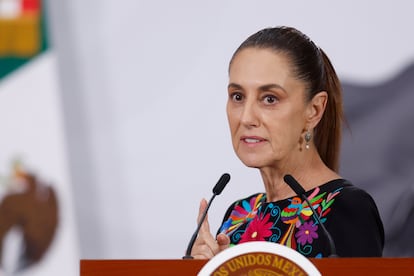
With a measured “no rush,” President Claudia Sheinbaum has indicated to economic interest groups the new guideline for the review of the USMCA, the core free trade agreement that Mexico shares with Canada and the United States. Setting aside the goal of a swift renegotiation on July 1, the President’s government has extended the schedule, in an attempt to prepare the ground for a longer-term and more uncertain scenario. “Regarding the treaty: we are making progress, there is no rush. Of course, we want the tariffs we currently have to decrease. That is very important to us. But as for the review, we are seeing when the right moment is,” she pointed out in one of her morning press conferences this week.
It is the first time in months of preparation that the Administration openly raises the possibility of postponing the renegotiation of the agreement, which moves about 2.5 billion dollars daily just at the border between Mexico and the US. The Secretary of Economy, Marcelo Ebrard, even went further and proposed a scenario of “reviews that are not conclusive for the next ten years,” while assuming that the USMCA will survive President Donald Trump’s tariff war and after being used as leverage in the coordination of non-commercial issues, such as migration or drug trafficking.
Less than two months before the meeting, there is little chance that the agreement will be denounced by any of the parties, as it has proven beneficial for the exchange of about 1.5 trillion dollars among the three economies; a significant amount in a context of inflationary pressures and weak global economic growth. However, the review is heading toward a negotiating limbo marked by the caution of the Mexican Government and pressure from the United States. By giving up on a quick negotiation, Sheinbaum’s Administration buys time but also transfers concerns to investment and reveals the asymmetries it maintains against an increasingly protectionist partner. More than a technical review, what is shaping up is a prolonged negotiation with the risk of politicization, where Mexico plays not to lose, even if that means postponing key decisions for its economy.
“We do not want the most political part of the elections in the United States and later in Mexico to influence, but rather a truly long-term vision of the three economies,” Sheinbaum said. Given this, it is assumed that the ideal scenario for Mexico, a unanimous extension for an additional 16 years with a new expiration date in 2042, will be exchanged for a prolongation with continuous talks until a renewal for 16 years before 2036 is agreed upon, or not.
Oscar del Cueto, president of AmCham Mexico, considers that the USMCA remains the forum to “North Americanize” the products consumed by this gigantic market and will continue to offer competitive advantages to companies that see Mexico as a manufacturing and export base. However, he maintains that companies must understand and adjust to the fact that Washington will not abandon its tariff policy in key areas for its economy and voter base. “The message was clear: no more free trade, tariffs will not disappear,” the businessman explained in his recent participation at the Council of the Americas in Mexico City. This is how he described the message conveyed by the US Trade Representative, Jamieson Greer, during his official visit three weeks ago.
The next meeting will be on May 28, where the next steps will be formalized. “We believe that July 1 will not be the total closure. There is much to integrate: the issue of artificial intelligence (AI), which is not included, copyright, and how to make exchanges more productive (…) we will not forget the agreement, it will be adjusted. A 2.2 agreement managed by Trump,” said the president in Mexico of the railway Canadian Pacific Kansas City (CPKC).
An agreement without Trump
For his part, Luis de la Calle, general director of CMM Consultores and a member of the team that negotiated the current treaty, is part of a small—though growing—group that thinks it might be better for Mexico to wait until the Republican finishes his term, then focus on the future commercial direction of the North American bloc. He explains that, in fact, the original team set 2026 for the review calculating that Trump would no longer be in power, even if he were immediately reelected. “You will remember that President Trump’s original position was that there would be a sunset clause, a clause of expiration: that when we reached 2026 the agreement would end unless the United States, Mexico, and Canada made a positive determination that they wanted it extended. Mexico and Canada did not accept that and a review mechanism was achieved,” he added. That extension can be used in favor of the country, he insisted.
“Mexico has to be very strategic, we should not rush into a bad agreement with the US and Canada, there is no reason. If by June 30 we do not reach an agreement, the treaty does not disappear, it continues,” he pointed out.
The president recently appointed reinforcements for the negotiating table, adding technical profiles in agricultural, financial, and industrial matters, with the vision that details will tip the balance. She also announced an ambitious incentive program for the private sector, including tax facilities and permit processing in crucial sectors for productive strength.
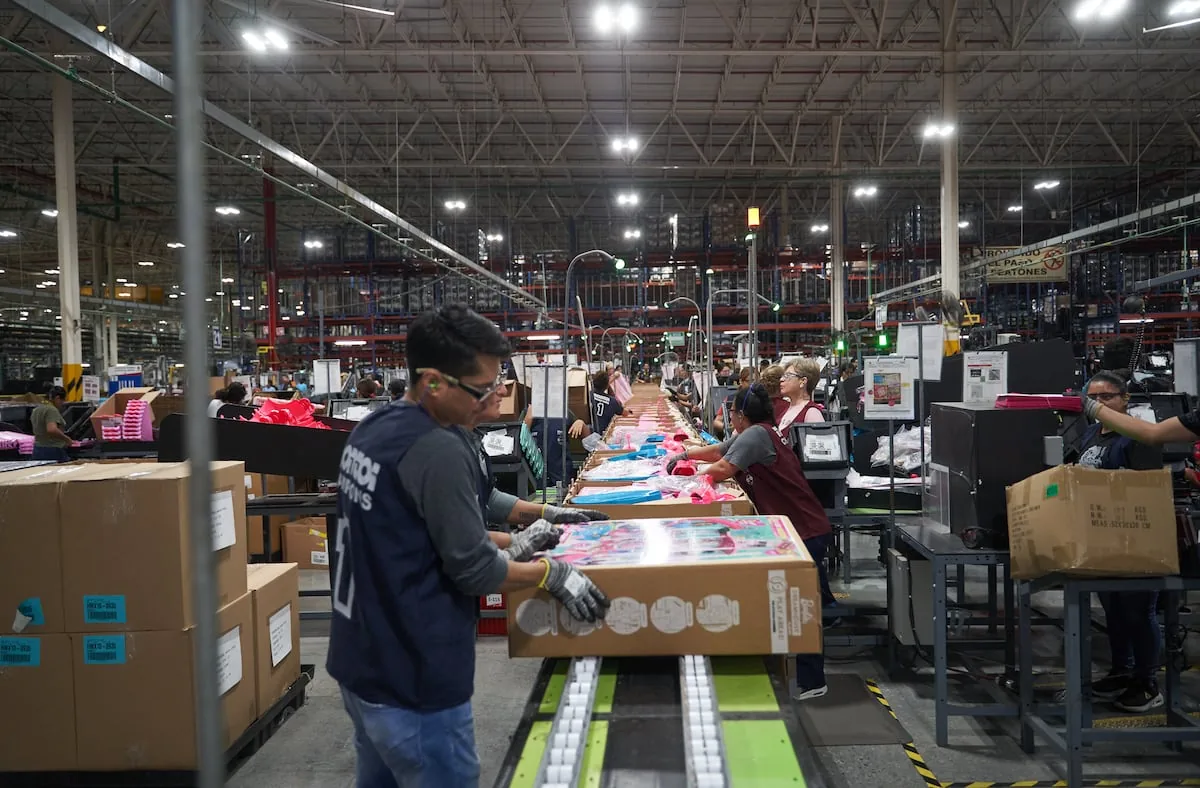
Mexico will arrive at the meeting with a solid export position but with several sensitive fronts open that will mark the discussion. Tensions persist around energy policy and its openness to private capital, a dispute over genetically modified corn, and the neighbor’s intention to increase regional content in the automotive sector’s rules of origin. One of the most sensitive points is the tariffs imposed by Trump on steel, aluminum, and tomatoes, which have hit local production and prices.
At the same time, Mexico seeks to promote nearshoring, although factors such as physical insecurity and legal certainty weigh increasingly on business decisions. And, in the background, noise increases due to the campaign in Washington ahead of the November midterm elections, as well as the renewed approach with China, which could revive doubts about the interest in relocating production chains to the country.
“We were quite surprised to see Secretary of Economy Marcelo Ebrard practically throw in the towel in his attempt to achieve a quick review of the USMCA, almost two months before the July deadline,” considered the wealth management firm Bradesco BBI in an analysis note. “In our opinion, Ebrard’s change of stance and the public acknowledgment of possible delays or annual reviews do not benefit Mexico at all in these negotiations, especially considering the unprecedented cooperation Mexico has shown in migration, security, and raising trade barriers with China,” it said, referring to the more than 1,400 tariff lines that the Latin American country introduced to its Asian imports.
The Brazilian investment bank reported that it conducted an exploratory visit along with potential foreign investors to the industrial market of the border city of Tijuana this week. “We confirmed a significant latent demand from companies seeking to establish operations in Mexico, although many remain on hold to see what the final tariff rules will be. While the federal government may be doing its best to encourage national private investment, removing this obstacle and leaving these negotiations with the US behind would be the most relevant factor in the short term,” it concluded.