





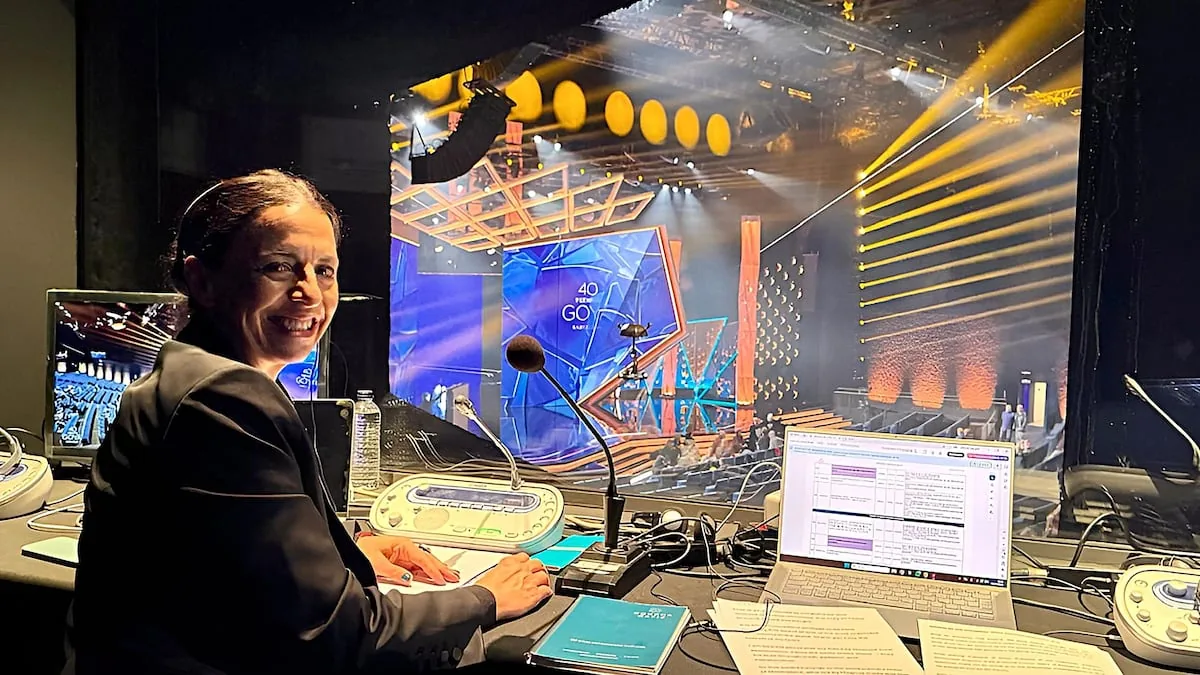
Concha Ortiz has spent 33 years adapting and reinventing herself as a translator and interpreter. Three decades in which, as she tells us, the emergence of artificial intelligence has not been the first revolution she has experienced: before that, she lived through the appearance of the internet and online searches, glossaries and terminological databases, translation programs, and remote simultaneous interpreting. All of them have been overcome and incorporated into her work.
Read more I have tried 6 face masks, and this is the one I would buy again and again
What is happening with AI and interpreting? “There have been occasions when, at some large international conferences, instead of human interpreters, AI has been used, creating subtitles that are generated on screen at the event or in the Zoom meeting.” But, in her opinion, AI-driven interpreting with live subtitles does not work for that type of communicative environment.
At the last Goya Awards Gala, Ortiz lent her voice to Susan Sarandon after the controversy over the use of subtitles in 2025 during Richard Gere’s speech, transmitting live and adding emotion to her words. As if it were magic, from before the age of AI.
The impact of AI on the sector
“From university, they teach you that the translator or interpreter is an invisible person, because the best translation is the one that goes undetected. But, in the current situation and with the advent of AI, we have probably done a poor job by not making visible the value we provide,” argues Arancha Caballer, president of the National Association of Translation and Interpreting Companies (ANETI). A challenge that clearly affects their sector, yes, but also many other professions.
Artificial intelligence is radically and rapidly changing the world of work, questioning what space remains for people. Studies such as the one published by the International Monetary Fund estimate that up to 70% of employment in developed countries – 40% globally – could be affected, and while it may increase the productivity of certain professions, in more than half of cases, their salaries and even their very existence could be at risk.
“We have been working with machine translation, a form of artificial intelligence, for a long time, but the fact that it is made available to so many people so easily, almost for free, and with this marketing campaign by tech companies, is something we cannot compete with,” comments Caballer. Clients are trusting the promises of AI-generated translation tool providers, and the real impact is being felt at an accelerated pace in the last year, leading to client loss and forcing professionals to rethink a business model that, in 2023, generated 700 million euros in revenue.
Given that mandatory professional registration for translators does not exist in Spain, it is difficult to know the exact number of practitioners, although the Official List of Sworn Translators from the Ministry of Foreign Affairs, updated to 2024, offers a figure of more than 14,000. Other studies, such as the one carried out by ANETI, estimated the number of linguistic service providers at almost 10,000 in 2023, of which 88.9% are self-employed —and 72.1% women—.
The impact of AI is clear, with drops in the business volume of classic translation from 37% to 29% of the total and decreases in rates for post-editing services (between 13% for independent professionals and 29% for companies). This scenario explains why up to 17% of self-employed professionals are already considering abandoning the profession, according to the .
The good news is that, even in the midst of a crisis, a positive side is also observed: some clients are choosing to return to traditional services. What language service companies provide, as the president of ANETI points out, is the professional handling of IT tools, the validation and risk control against AI errors and hallucinations, specialization in specific fields (scientific, legal, engineering, or medicine, among others), the adaptation of message tone to different audiences, and their capacity for managing and coordinating large teams in an international and multicultural environment.
The impact, in any case, transcends the labor market and is also noticeable in training centers, which strive to react and strengthen human value against translation by artificial intelligence.
Read more Which 3D printer is better: resin or filament?

The reinvention of training
In any case, translation studies maintain a broad offering, with 72 active degree programs (61 in public centers and 11 in private ones) and 24 universities affiliated with the Association of Spanish State Universities with Official Translation and Interpreting Degrees (AUnETI).
“We perceive AI as a threat, but we have to see it as a tool. We have overcome many similar predicaments throughout the history of translation and we are prepared,” reflects Cristina Álvarez de Morales, dean of the Faculty of Translation and Interpreting at the University of Granada (UGR), a benchmark in this field and the second oldest in Spain. Álvarez acknowledges a very recent decrease in demand for places, although she points out that it is not widespread and is, on the contrary, compatible with maintaining a high degree of national and international attraction.
The University, far from turning its back on the new phenomenon, has created artificial intelligence guides and ethical committees, maintaining various teaching innovation projects in the field and incorporating subjects on IT tools and postgraduate specializations in translation technologies.
“Our students maintain a very high degree of employability. They are very versatile students with technological skills,” Álvarez points out. Not only in traditional occupations, but also in different fields such as linguistic mediation; conference interpreting in conflict zones; post-editing – correction and control of automated translations; localization – adaptation to context and cultural reality – in video games and multimedia products; technical writing; tourist and museum accessibility, or accessibility for people with disabilities and sign language.
New translators: growing amidst the revolution
“I am a translator, but also a programmer. I studied both at the same time because I was very interested in technology focused on linguistics, and right now I work as a technical writer for a software company,” explains Arnau Calderón, a 2023 graduate, whose educational combination was not common just a few years ago. For him, the advent of AI was not a surprise, as he lived his entire career with the threat of translation automation. Something that, despite the recent leap, is nothing new: computer-assisted translation programs like Trados were launched in the 1980s.
Arnau is very aware of the risks of using language-based models (LLMs, Large Language Models) that are currently at the core of generative AI: “It is programmed to answer very fluently, and when it doesn’t know something, it will answer anyway. If you correct it, it will agree with you, and even thank you, even if it continues to do the same thing. It used to be said that to err is human, but now it’s also a matter for computers.”
José Moya, a 2022 graduate in translation and interpreting from the University of Granada, works as a computational linguist, a profile bridging language, computer science, and artificial intelligence, aimed at “teaching computers how to interact with people.” When choosing his topic for his final degree project, he already knew what he wanted: since everyone was talking about the metaverse, he wanted to know what the world of translation would be like in that environment, focusing on analyzing the possibilities of machine translation with augmented reality and post-editing.
He subsequently continued his education and specialized with a Master’s in Tradumatics from the Autonomous University of Barcelona; he worked in the sector in the United States and returned to create his own company focused on accessibility, with innovative research areas such as the detection of diseases and pathologies in underserved individuals through voice tonality.
Moya is clear about the path for his profession: “Speed is no longer the differential advantage; judgment is. And the more delicate the context, the more important the human being remains.”