







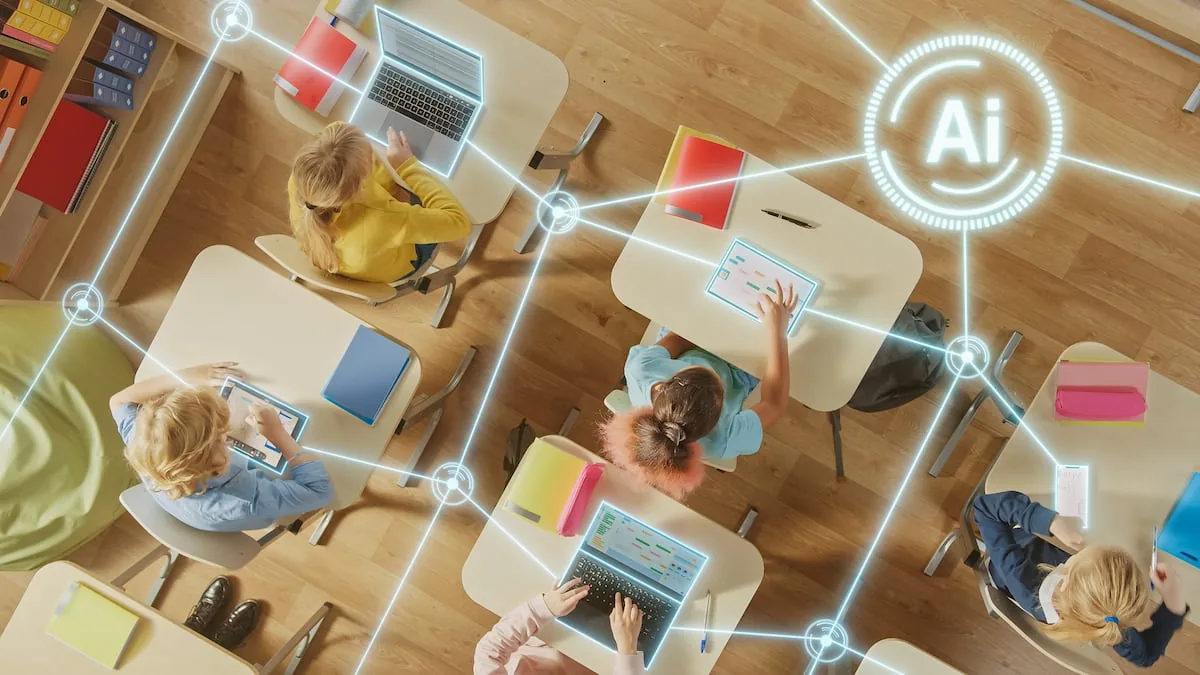
School has entered the AI era without an instruction manual. In just two school years, generative artificial intelligence tools like ChatGPT or Gemini have gone from being a curiosity to becoming part of the daily routine of teachers and students, and the discussion is no longer whether they will be used, but rather how. Moreover, this debate has ceased to be limited to Primary or Secondary classrooms: universities have also begun to integrate these technologies into their teaching, learning, and assessment processes, although they still do so in a transitional scenario, with more questions than certainties.
Read more Ayuso to Vox: “They are treating immigrants like scum. What I defend is law and order”
The European regulatory framework is beginning to take shape. The EU Artificial Intelligence Act considers systems that decide access to centers, evaluate learning, or supervise exams as “high risk,” which requires extreme guarantees. Meanwhile, organizations like UNESCO have been repeating a warning that has become common in this debate: technology should not enter the classroom by inertia, but only when it genuinely contributes to learning and with clear rules for those who use it.
In Spain, the framework is not new either. The Ministry of Education published a guide on the use of generative AI in the classroom focused on teacher training, transparency, and data protection. At the same time, Congress is processing a law to protect minors in digital environments that, among other measures, will allow schools to regulate mobile phone use and strengthen education on screen habits.
The classroom has already changed
AI has also begun to sneak into the classroom as a tool to change the way students learn, not just what they do. In systems like Gemini, for example, the student can activate a “guided learning” mode that alters the usual dynamic: instead of merely providing a closed answer, the tool returns questions, asks for explanations of the steps taken, suggests intermediate paths, or proposes similar exercises to check if what has been learned holds outside the initial example.
“The pedagogical possibilities that AI opens aim to make learning more attractive, effective, and personal, allowing students to use it as a means to explore their curiosity, rather than as an exclusive end to perform tasks,” says Maureen Heymans, Vice President of Learning Engineering at Google.
“With this mode, the intention is different: it is not just about getting an answer, but about learning,” explains Marc Sanz, Director of Education at Google for the Iberian Peninsula, Middle East, and Africa. The key is not so much the tool itself but how it is used: moving from using AI as a shortcut to solve tasks to turning it into support to better understand content, and clearly defining at which points in the learning process it makes sense to use it and when it does not. In some cases, this already translates into specific guidelines in the classroom: teachers who delimit in which phases of a project AI can be used — for example, to generate ideas or review a draft — and in which it must be excluded.
The progressive introduction of these tools according to age is another key aspect. In Early Childhood and Primary stages, Julia Wilkowski, Director of Pedagogy at Google, points out, “it must always be done in collaboration with an adult,” since young students do not yet have the critical maturity necessary to evaluate responses. And only when they have acquired basic skills in reading, writing, or mathematics (from age 13, according to her recommendations) does it make sense for AI to become an autonomous support to expand or reinforce learning.
The same debate — how to use AI and with what limits — has begun to strongly move into higher education, where its impact affects not only the way of studying but also how teaching is organized and students are assessed.
University as an AI laboratory
This same adaptation process has begun to accelerate in higher education, where artificial intelligence is not only used as occasional support but is starting to be integrated into the very functioning of teaching. At universities like the Universitat Oberta de Catalunya (UOC), this change is already being addressed more structurally, with the creation of a specific center that seeks to organize its use and apply it where it can truly improve processes.
“What changes is the approach: we move from initiatives that arise in a scattered way to a more strategic vision, in which we identify which processes we want to improve and how AI can help us do so,” explains Ricard Gómez, Deputy Manager of Digital Transformation at UOC. The key, he adds, is not to incorporate technology by inertia but to do so with concrete objectives and under criteria of efficiency, ethics, and control.
In practice, this change is already noticeable in very specific tasks. One of the most evident is feedback to the student, especially in contexts with large volumes of students. “AI must be an augmenter of teachers’ capabilities, not a substitute,” Gómez summarizes. “It can help analyze the student’s work and pre-draft quality feedback, so the teacher can offer a richer response without having to invest the same time reviewing the entire process.”
This support also extends to student monitoring, although it often goes unnoticed. In a university with nearly 100,000 students, early detection of who needs help is not trivial. “We can identify activity patterns that indicate a student is having difficulties or at risk of dropping out and focus efforts there,” he explains. The result, more than an automated intervention, is a feeling of greater closeness: the student perceives more personalized support, even if they do not directly see the technology behind it.
Beyond the short term, AI also opens the door to new ways of organizing learning. From the possibility of adapting the same content to different formats — audio, video, or interactive materials — to allowing the student to decide how they want to access that information at any given moment. A change that affects not only teaching but also the very experience of learning.
Assessment at the center of change
Beyond tools or specific uses, the deepest impact of artificial intelligence in education points to a more delicate area: assessment. For decades, the system has largely relied on tests that measure the ability to recall and reproduce learned information. But that model is beginning to crack in a context where any student can access elaborated answers of high quality in seconds.
“What makes no sense is a memorization-based assessment or one based on reproducing content that artificial intelligence can generate immediately,” Gómez suggests. The problem, he adds, is not so much that students use these tools — something taken for granted — but that the system continues to measure learning in the same way as before.
Read more Live video | Trial of the ‘Kitchen case’, the police corruption scheme linked to the PP
This mismatch has opened a transitional phase in which rules trying to limit AI use coexist with practices increasingly widespread among students. “We are at a moment when some try to prevent it and others push the limits,” he summarizes. But, in the medium term, change seems inevitable: assessment will have to shift toward models that are not based on memory but on the ability to interpret, relate, and apply knowledge.
In that scenario, the boundary between learning and assessing tends to blur: “Assessment should be integrated into the learning process itself, not concentrated at a single moment,” Gómez explains. This opens the door to more continuous monitoring forms, in which the student’s progress is measured through their interaction with content, the questions they ask, or how they construct their own answers.
The challenge is no small matter. As various experts have warned, AI-generated text detection systems remain unreliable and can lead to errors or discrimination. The increasingly shared alternative is to redesign tasks: giving more weight to the process than the final result, requiring explanations, comparisons, or analyses that force the student to take a position and make their reasoning explicit.
At its core, it is a change of logic. If knowledge is available almost immediately, what becomes relevant is not so much remembering it but knowing what to do with it. And there, artificial intelligence ceases to be a problem to control and becomes another element of the learning process itself.
A process with advantages and risks
The spread of these tools is also having an immediate impact on daily teaching. One of the most visible is time. A study by the Education Endowment Foundation in English schools published in December 2024 shows that secondary school teachers who use generative AI with a guide of best practices reduce planning time by 31%. It is not about replacing the teacher, but freeing up hours for tasks of greater educational value.
This saving coexists with one of AI’s most repeated promises: personalized learning. The possibility of adapting materials to each student’s level, pace, or style, offering more immediate feedback, or generating dynamic content opens the door to more flexible teaching but also raises questions: “AI can amplify inequalities if not used properly, because not all students start from the same point. A student with learning difficulties, such as dyslexia or ADHD, may receive recommendations that do not fit their needs, while others advance faster if there are no compensation mechanisms,” warns Juan Luis Moreno, Executive Director at The Valley. In other words, personalization only works if accompanied by sufficient resources for those who need them most.
However, the debate is not limited to equity, as it also affects how students relate to knowledge in an increasingly screen-mediated environment. “The risk is not only what they do with AI but how much time they spend connected and under what conditions,” says Jordi Cirach, an expert in digital well-being. Hence the importance of introducing clear limits, alternating with analog activities — such as handwriting or working without devices — and teaching to critically evaluate the information they receive. In that balance, he reminds, part of learning is also at stake.
Added to this is a less visible but equally relevant risk: always taking the technology’s answers as correct: “The natural way is to accept what the machine returns without questioning it. That is why the student must be forced to compare, analyze, and take a position,” Gómez points out. Instead of avoiding AI, the challenge is to design tasks that require that effort: contrasting answers, identifying differences, or justifying why one solution is better than another.
But even in that scenario, there is an idea that experts repeatedly emphasize: technology does not replace the most human dimension of learning. “The real value remains in the teacher’s ability to inspire, motivate, and teach how to think,” Moreno recalls.
Limits, control, and governance
Beyond the classroom, challenges also move to the institutional level. The expansion of AI not only requires training teachers and students but also establishing control mechanisms to ensure its proper use. “There is a risk that these tools are deployed in a distributed and uncontrolled way. We need to govern them to make sure they do what we want them to do,” warns Gómez.
This need for supervision connects with warnings from organizations like the Spanish Data Protection Agency, which insists on assessing risks and minimizing the use of personal information, especially when minors are involved. Also with the European framework, which requires extreme guarantees in systems that affect sensitive educational decisions.
The emerging picture is not one of immediate transformation but of a gradual change that forces a review of some of the pillars of the educational system. Teacher training, task redesign, transparency with families, and a balanced combination of digital and analog environments appear as necessary conditions for technology to fulfill its promise.
Because, ultimately, the challenge is not so much incorporating artificial intelligence as deciding what role we want it to play in education. And that is a conversation that can no longer be postponed.
Read more What are books for?